Single-cell RNA sequencing (scRNA-seq) has transformed the way researchers investigate complex tissues. Instead of averaging signals across millions of cells, scRNA-seq can reveal transcriptional heterogeneity at the level of individual cells, helping researchers identify cell types, cellular states, disease-associated populations, and molecular programs that may otherwise remain hidden.
But identifying genes that change is often only the beginning.
A typical differential expression analysis can tell us which genes are expressed differently between two conditions. What it cannot necessarily tell us is which genes are driving those changes, how regulatory relationships are being disrupted, or what may happen if a particular gene is perturbed.
This is where computational gene perturbation approaches such as scTenifoldKnk become particularly interesting. By constructing gene regulatory networks from scRNA-seq data and computationally removing a target gene from the network, scTenifoldKnk provides a way to explore the potential regulatory consequences of gene knockout in silico before committing to extensive experimental perturbation studies.
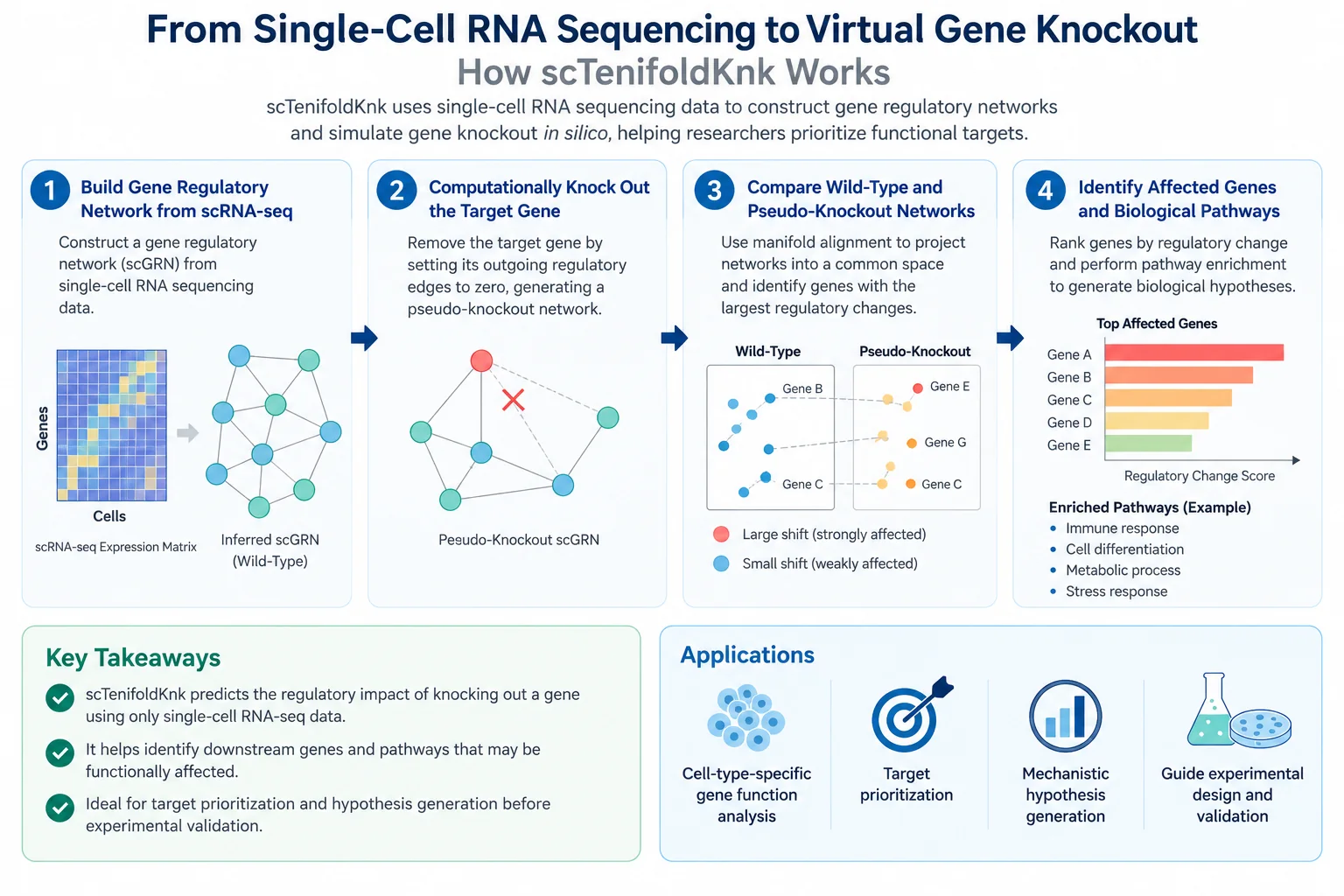
Figure 1. Conceptual workflow of scTenifoldKnk, from scRNA-seq input and regulatory-network reconstruction to virtual knockout, network comparison, and candidate pathway prioritization.
Differentially expressed genes (DEGs) are among the most common outputs of transcriptomic studies. Suppose a disease-associated cell population contains hundreds of genes that differ significantly from a control population. Some may represent important regulatory changes. Others may simply be downstream consequences of another molecular event.
Expression level and regulatory importance are not necessarily the same thing. A transcription factor, for example, may substantially alter the regulatory state of a cell without becoming one of the most dramatically differentially expressed genes itself. Conversely, a highly differentially expressed gene may be responding to an upstream event rather than driving it.
Gene regulatory network analysis approaches the problem from another perspective: rather than asking only “Which genes changed?”, it asks “How did the relationships among genes change?”
scTenifoldKnk is a machine-learning workflow developed for performing virtual gene knockout experiments using scRNA-seq data.
One useful feature is that the method can operate using scRNA-seq data from wild-type or unperturbed cells alone. Experimental knockout data are not required as input. Instead, the algorithm reconstructs a single-cell gene regulatory network (scGRN) from the observed transcriptomic data, generates a pseudo-knockout network by removing the selected gene’s outgoing regulatory edges, and compares the perturbed and original networks.
The output is therefore not simply another list of differentially expressed genes. It is a prediction of differentially regulated genes associated with perturbation of the target gene.
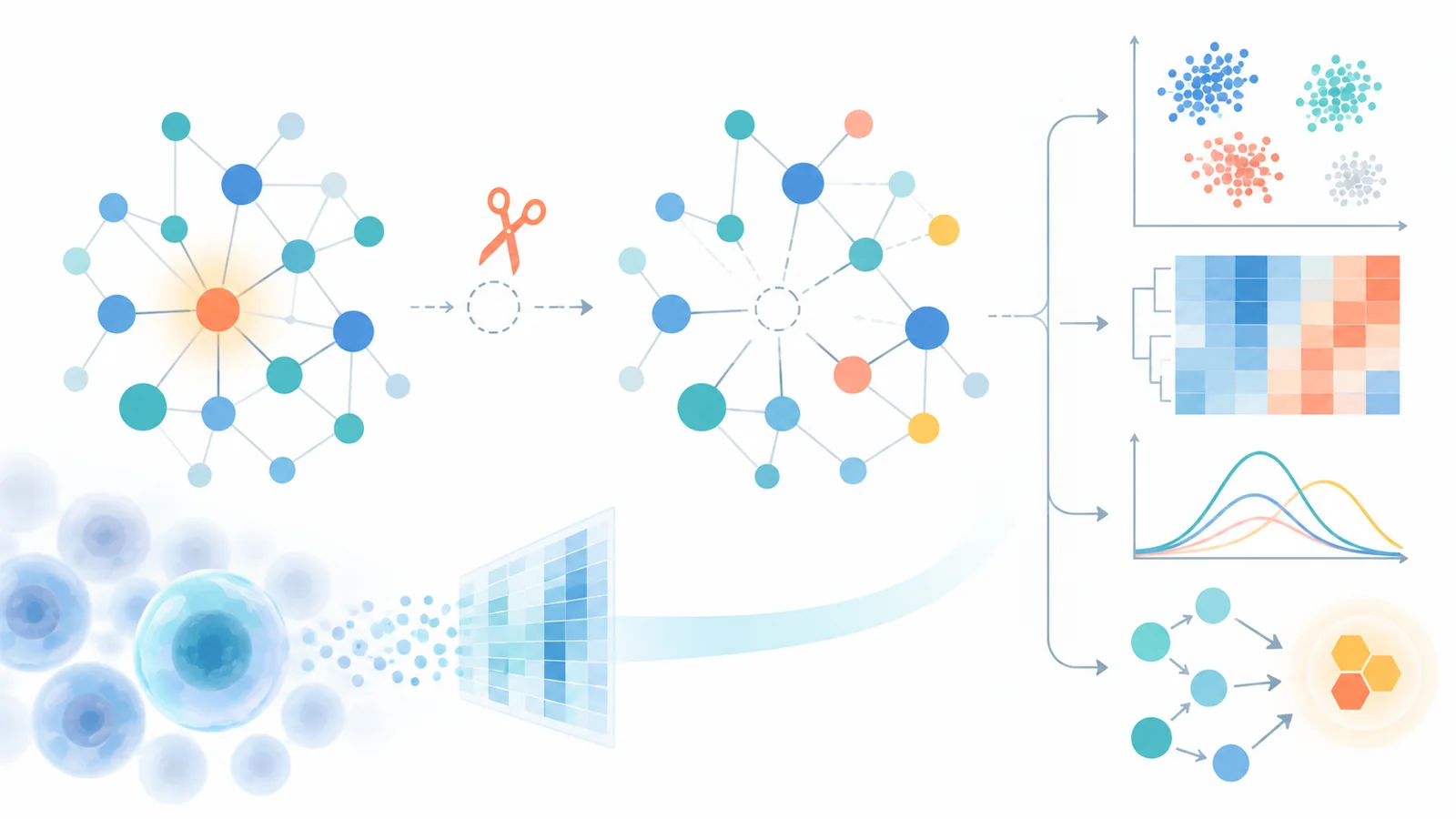
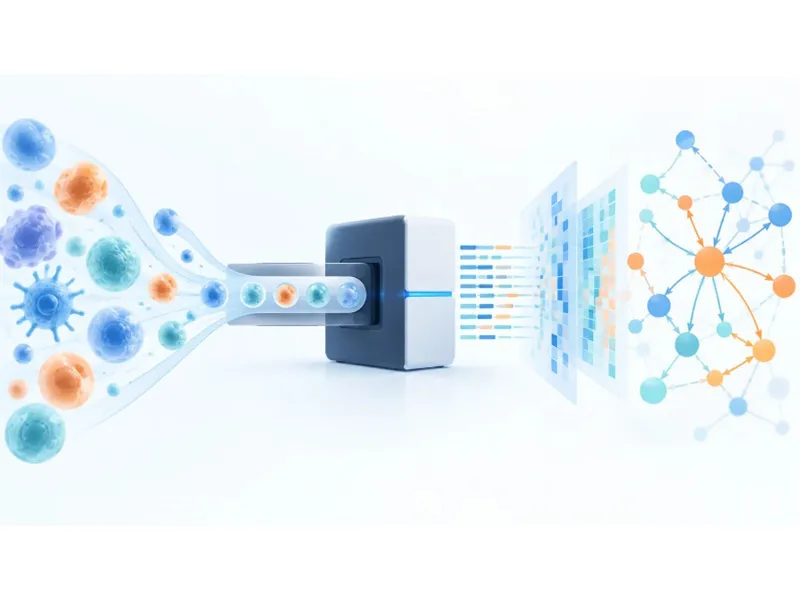
Figure 2. Conceptual illustration of an inferred gene regulatory network before and after an in silico perturbation, followed by downstream pattern and pathway analysis.
The analysis begins with a gene-by-cell expression matrix generated from single-cell RNA sequencing. The scTenifold framework repeatedly samples cells and uses principal-component regression to construct multiple gene regulatory networks. Tensor decomposition is then used to extract reproducible structure across network estimates and reduce noise.
Once the network has been constructed, the selected target gene is virtually removed by setting its outgoing regulatory edges in the network adjacency matrix to zero. This creates a pseudo-knockout scGRN. No cells have actually been genetically modified; the perturbation occurs within the inferred regulatory network.
scTenifoldKnk uses manifold alignment to project the wild-type and pseudo-knockout networks into a shared lower-dimensional space. Each gene receives a representation in both networks, and the distance between those representations reflects how strongly its regulatory context changes following the virtual knockout.
Genes showing large and statistically significant regulatory changes can be ranked and subjected to downstream functional analyses such as Gene Ontology or pathway enrichment. These results are best interpreted as hypothesis-generating evidence that can help prioritize genes and pathways for further experimental investigation.
One of the major advantages of this approach is its ability to examine gene function in a cell-type-specific context. A gene may play different regulatory roles in macrophages, epithelial cells, fibroblasts, T cells, or malignant cells. Because scRNA-seq enables computational separation of these populations, regulatory perturbation analysis can be performed within biologically relevant cell populations rather than across a bulk mixture.
In the original scTenifoldKnk study, the authors applied the method to datasets derived from real knockout experiments. Using wild-type scRNA-seq data for virtual-knockout analysis, the method recovered major aspects of gene functions reported in the corresponding experimental studies. This does not mean computational knockout can replace experimental knockout; it suggests that single-cell data can help researchers narrow a large search space before more resource-intensive validation.
Differential expression and differential regulation answer different questions. DEG analysis identifies changes in transcript abundance between biological conditions, whereas scTenifoldKnk evaluates how removal of a gene is predicted to disturb its surrounding regulatory network.
For many studies, the most informative strategy is to integrate both approaches: clustering and annotation establish the cellular landscape; differential expression identifies condition-associated transcriptional programs; regulatory-network analysis adds mechanistic context; and virtual perturbation helps prioritize potential drivers for experimental follow-up.
Like any computational perturbation method, scTenifoldKnk should be interpreted carefully. Its predictions are derived from an inferred gene regulatory network rather than direct biological manipulation, so performance depends on the quality and biological relevance of the underlying single-cell dataset.
The method was developed for virtual knockout rather than gene overexpression, and inferred regulatory relationships should not automatically be interpreted as direct biochemical regulation. Virtual knockout is therefore most appropriate for target prioritization and hypothesis generation, followed where appropriate by experimental perturbation, molecular assays, imaging, functional studies, or other orthogonal validation.
Omics Empower provides single-cell RNA sequencing and bioinformatics support from experimental design through downstream data analysis, helping researchers move from complex biological samples to interpretable cellular and molecular insights.
Whether your study aims to characterize cellular heterogeneity, identify disease-associated cell states, investigate regulatory mechanisms, or prioritize candidates for downstream functional studies, our team can help design a single-cell workflow around your biological question.
Our team has supported more than 500 peer-reviewed publications across single-cell and spatial transcriptomics research, including studies published in Nature, Science, and Cell.
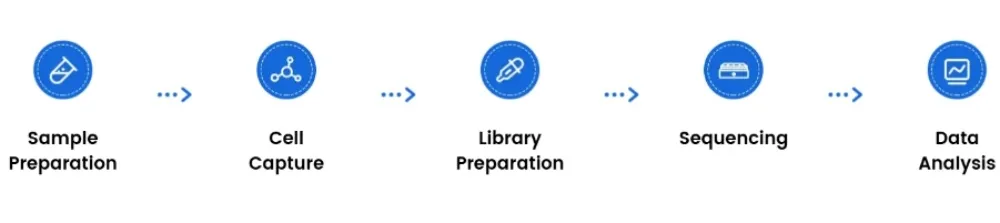
Omics Empower workflow overview
Whether you are working with fresh cells, fresh tissue, frozen samples, or clinically collected material, we can help assess the most suitable workflow for your project.
1. Osorio D, Zhong Y, Li G, et al. scTenifoldKnk: An efficient virtual knockout tool for gene function predictions via single-cell gene regulatory network perturbation. Patterns. 2022;3(3):100434. doi:10.1016/j.patter.2022.100434.
2. Osorio D, Zhong Y, Li G, Huang JZ, Cai JJ. scTenifoldNet: A Machine Learning Workflow for Constructing and Comparing Transcriptome-wide Gene Regulatory Networks from Single-Cell Data. Patterns. 2020;1(9):100139. doi:10.1016/j.patter.2020.100139.
Germany: Arnold-Graffi-Haus / D85 Robert-Rössle-Straße 10 13125 Berlin
United States: (CA) 2 Goddard, Irvine, CA 92618
United States: (IL) 8255 Lemont Rd, #1, Darien, IL 60561
Hong Kong: Unit 615, Building 11W, Hong Kong Science Park, Pak Shek Kok, Hong Kong
Germany: Arnold-Graffi-Haus / D85 Robert-Rössle-Straße 10 13125 Berlin
United States: (CA) 2 Goddard, Irvine, CA 92618
United States: (IL) 8255 Lemont Rd, #1, Darien, IL 60561
Hong Kong: Unit 615, Building 11W, Hong Kong Science Park, Pak Shek Kok, Hong Kong
Germany: Arnold-Graffi-Haus / D85 Robert-Rössle-Straße 10 13125 Berlin
United States: (CA) 2 Goddard, Irvine, CA 92618
United States: (IL) 8255 Lemont Rd, #1, Darien, IL 60561
Hong Kong: Unit 615, Building 11W, Hong Kong Science Park, Pak Shek Kok, Hong Kong

 EN
EN
 de
de