Since 2009, single-cell sequencing has moved from a novel method to a standard approach in many areas of biology. Today, it is routinely applied in cancer research, neuroscience, immunology, and developmental studies. Along with this growth, several high-throughput platforms have become available, each with its own strengths and trade-offs.
With multiple commercial platforms available, researchers face the question of which system best matches their study design, sample type, and budget. Drawing from Omics Empower’s experience running projects across our laboratories worldwide, this article reviews several mainstream single-cell sequencing platforms and highlights their respective strengths.
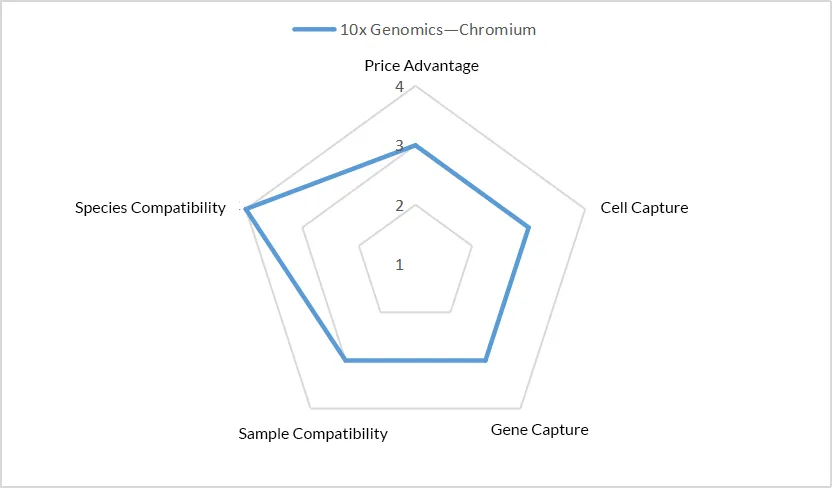
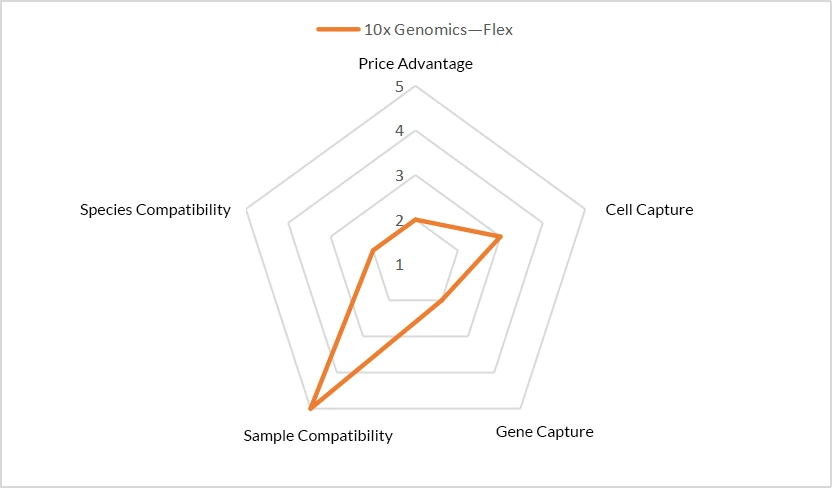
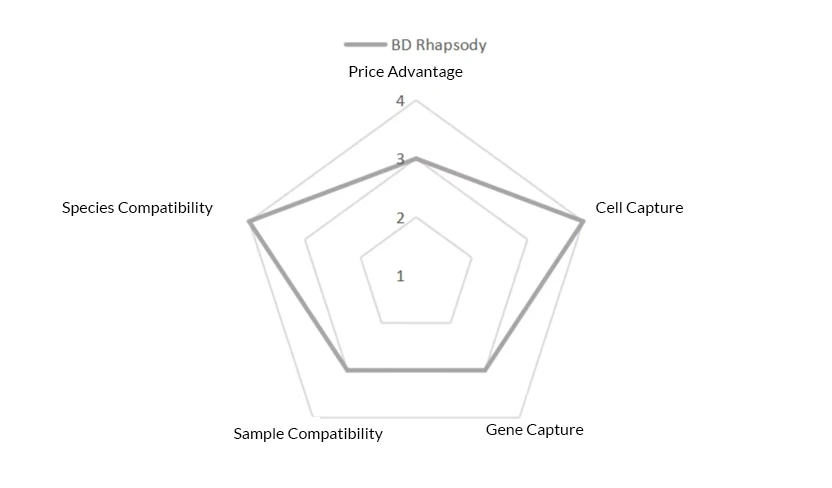
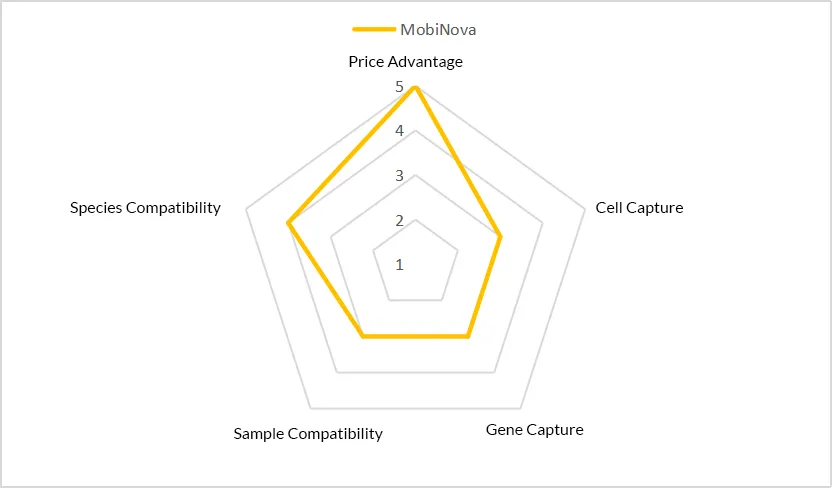
All platforms were assessed across five dimensions, each rated on a 1–5 scale (1 = low, 5 = high):
Cost advantage: Low → High (relative reagent and per-cell costs)
Gene capture: Low → High (sensitivity, number of detected genes)
Cell capture: Low → High (efficiency and recovery of single cells)
Sample compatibility: Fresh, gradient-frozen, -80 °C frozen, liquid nitrogen–frozen, FFPE
Species compatibility: Human, mouse, rat, other eukaryotes, microbial cells
Each metric reflects the general performance of the platform as a whole and does not target specific sample types. The evaluation does not represent an industry consensus; it is a preliminary assessment by Omics Empower based on five dimensions, provided for reference only. Final interpretation remains with Omics Empower.
The four platforms discussed here were selected because they are the ones most frequently used in Omics Empower’s projects. The comparison is based on our practical experience and is shared here for the reference of the research community.
The Chromium system from 10x Genomics remains the most widely adopted single-cell RNA-seq platform globally, often chosen by more than 80% of researchers. Its droplet microfluidics design enables high-throughput profiling with strong reproducibility.
Key details:
Throughput: Up to 10,000 cells per channel across 8 parallel channels (~80,000 cells per run)
Capture efficiency: Up to ~65% recovery of single cells
Low multiplet rate: <0.9% per 1,000 cells, ensuring cleaner data
Sample flexibility: Compatible with fresh, frozen, gradient-frozen, and FFPE tissue
Species range: Broadly validated across human, mouse, rat, and other eukaryotes
Chromium is considered the “classic” platform—a robust choice when high cell numbers and sensitivity are required.
The FLEX chemistry extends Chromium’s capabilities, addressing challenges with sample preservation and study design.
Key details:
FFPE compatibility: Unlocks single-cell sequencing for archived samples, a common limitation in traditional workflows
Fixation stability: 4% paraformaldehyde (PFA) fixation locks RNA states in place for reliable downstream analysis
Multiplexing power: Up to 16 samples per channel, 128 per chip—enabling million-cell scale experiments
Multi-site utility: Suitable for multi-center and multi-timepoint projects where samples are collected under different conditions
FLEX is best described as the “flexible” platform, enabling projects that involve archival material or complex logistics.
The BD Rhapsody platform uses a microwell-based approach to capture single cells. A microwell array containing 200,000 wells with a diameter of 50 µm is combined with 35 µm magnetic beads carrying cell-specific barcodes. Cells and beads are co-localized in the wells, and magnets are then used to recover the beads into tubes for downstream reverse transcription and library construction.
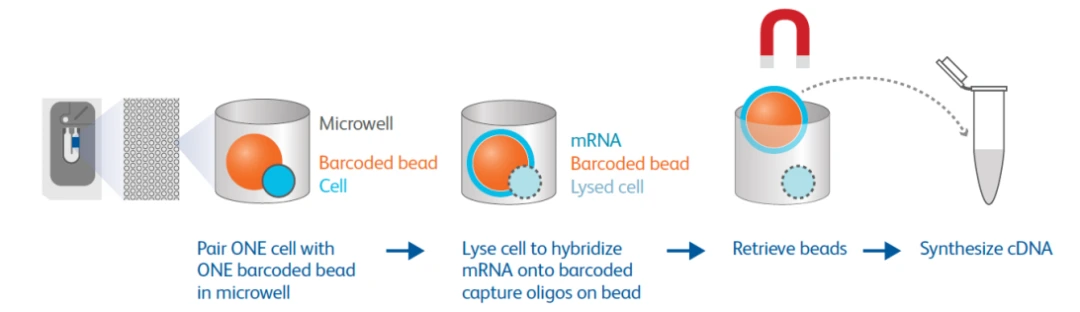
Source: BD Rhapsody website
Key details:
Capture technology: Cells settle into 50 µm microwells, paired with 35 µm barcoded magnetic beads
Viability tolerance: Performs with cell suspensions at ~65% viability
Capture rate: Up to 70%—among the highest in the field
Real-time monitoring: The BD Rhapsody™ Scanner allows researchers to observe microwells during capture and decide when to terminate runs
Protein + RNA profiling: Fully compatible with CITE-seq, Cell Hashing, and AbSeq kits for combined transcriptome and surface protein analysis
With its ability to combine RNA and protein readouts, BD Rhapsody is widely applied in immunology studies where surface marker phenotyping is as important as transcriptomic profiling. In addition, its tolerance for lower-viability suspensions (~65%) makes it suitable for clinical samples that may not meet the quality thresholds required by other platforms.
MobiDrop (also known as MobiNova-100) is a newer droplet-based system that emphasizes flexibility and cost control.
Key details:
Cost advantage: Lower per-cell reagent costs compared with most droplet-based systems
Throughput flexibility: Adjustable to match both small pilot studies and larger cohorts
Automation: Streamlined workflow integrates capture, library prep, and nucleic acid extraction in one step, reducing error and variability
Data quality: High reproducibility with robust performance across RNA and potential multi-omics applications
Sample scope: Effective with fresh, frozen, and FFPE samples
MobiDrop is the “cost-effective” platform, making high-resolution single-cell studies more accessible, particularly for labs managing larger projects under tighter budgets.
Every platform has its strengths, and the best choice depends on project design, sample availability, and budget:
10x Genomics Chromium for high-throughput and reproducibility
10x FLEX for FFPE and multiplexed designs
BD Rhapsody for protein–RNA integration and lower-quality samples
MobiDrop for cost-efficient, scalable workflows
At Omics Empower, we provide end-to-end single cell sequencing services using 10x Genomics and MobiDrop, the two platforms that offer the right balance of performance and accessibility for most research needs. With laboratories in Germany, Hong Kong, and the United States, we support projects globally——from pilot-scale studies to multi-site research collaborations that include patient-derived samples.
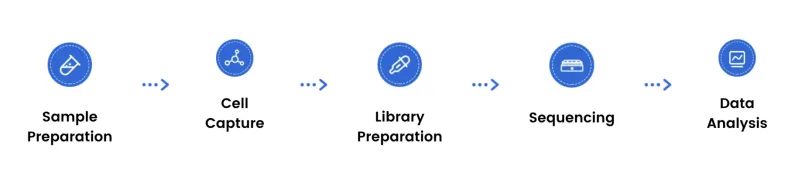
Contact us today to discuss your study—we will help you design and execute a single-cell sequencing strategy tailored to your research goals.
If you are planning a single-cell sequencing project, these articles may help you evaluate cell sorting strategies, compare platform options, and optimize your experimental workflow from sample preparation to downstream analysis:
l How Single-Cell RNA-Seq Reveals Neural Organoid Patterning
l 10x Flex Single-Cell Sequencing FAQ
l How to Use Flow Cytometry (FACS) Effectively for Single-Cell Sequencing
l Understanding Single-Cell ATAC-Seq
l Is Cell Subtype Annotation Necessary in Single-Cell RNA Sequencing?
Germany: Arnold-Graffi-Haus / D85 Robert-Rössle-Straße 10 13125 Berlin
United States: (CA) 2 Goddard, Irvine, CA 92618
United States: (IL) 8255 Lemont Rd, #1, Darien, IL 60561
Hong Kong: Unit 615, Building 11W, Hong Kong Science Park, Pak Shek Kok, Hong Kong
Germany: Arnold-Graffi-Haus / D85 Robert-Rössle-Straße 10 13125 Berlin
United States: (CA) 2 Goddard, Irvine, CA 92618
United States: (IL) 8255 Lemont Rd, #1, Darien, IL 60561
Hong Kong: Unit 615, Building 11W, Hong Kong Science Park, Pak Shek Kok, Hong Kong
Germany: Arnold-Graffi-Haus / D85 Robert-Rössle-Straße 10 13125 Berlin
United States: (CA) 2 Goddard, Irvine, CA 92618
United States: (IL) 8255 Lemont Rd, #1, Darien, IL 60561
Hong Kong: Unit 615, Building 11W, Hong Kong Science Park, Pak Shek Kok, Hong Kong

 EN
EN
 de
de