
In multi-omics research, it is not uncommon to encounter puzzling results: a protein shows high expression in proteomics, yet the transcriptomics data reveal little or no change at the mRNA level. Does this mean the data are unusable? Not necessarily. Such discrepancies often provide valuable biological insights when interpreted in the right context.
One of the most common explanations is post-translational modification (PTM). Proteins can be stabilized—or destabilized—through modifications such as ubiquitination, phosphorylation, or acetylation. This leads to protein accumulation (or degradation) independent of transcriptional changes.
To illustrate this mechanism, let’s look at triple-negative breast cancer (TNBC), where TEM8 protein accumulation provides a clear example.
TNBC progression is strongly linked to tumor vascular mimicry (VM), a process where tumor cells form vessel-like structures to sustain growth. Immunohistochemistry showed that TEM8 protein was highly expressed in TNBC tissues, compared with adjacent non-cancerous tissue and other breast cancer subtypes (Figure 1). Functional assays confirmed that TEM8 promotes VM formation, thereby accelerating TNBC progression.
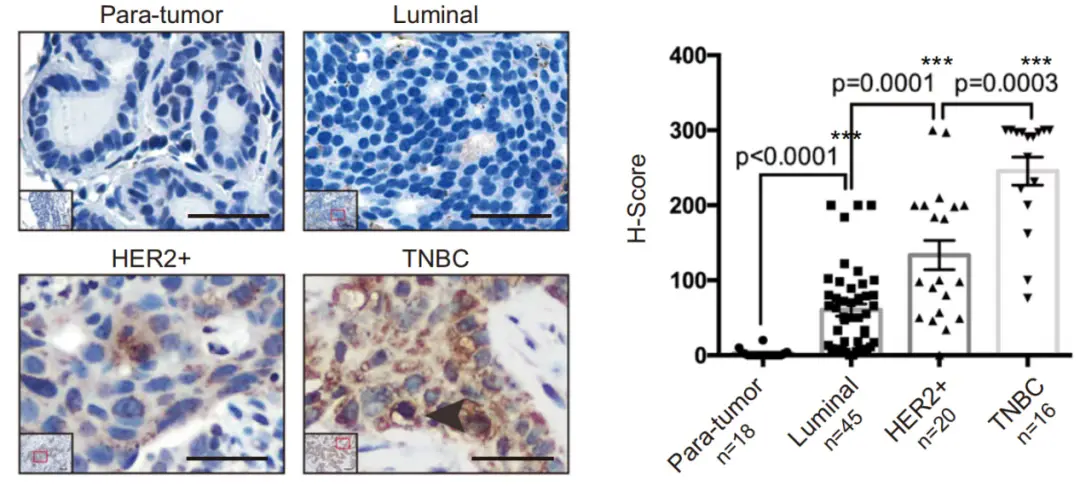
Figure 1. Immunohistochemical analysis of TEM8 protein in adjacent normal and tumor tissues from breast cancer patients. Black arrows indicate cells with high TEM8 expression.
However, RNA-seq and qPCR analyses revealed that TEM8 mRNA levels in TNBC were not significantly elevated compared with other breast cancer subtypes (Figure 2). In fact, luminal breast cancers sometimes showed higher transcript levels than TNBC. This mismatch suggested post-translational regulation.

Figure 2. Detection of TEM8 mRNA expression levels across different breast cancer subtypes.
To test whether TEM8 was regulated through the ubiquitin–proteasome system, researchers treated breast cancer cells with MG132, a proteasome inhibitor. TEM8 protein levels increased significantly after treatment, confirming that TEM8 is normally degraded via ubiquitination.
To identify the responsible E3 ubiquitin ligase, the team conducted a yeast two-hybrid screen using TEM8 as bait. Screening against a human E3 ligase library identified six candidate E3 enzymes that might interact with TEM8 (Figure 3).
.webp "Yeast_two-hybrid_screening_identified_six_candidate_E3_ubiquitin_ligases_that_may_interact_with_TEM8_(1).webp")
Figure 3. Yeast two-hybrid screening identified six candidate E3 ubiquitin ligases that may interact with TEM8.
Subsequent shRNA knockdown experiments revealed ASB10 as the critical regulator:
Knocking down ASB10 reduced TEM8 ubiquitination, leading to higher TEM8 protein levels and increased VM formation.
Overexpressing ASB10 enhanced TEM8 ubiquitination, reducing protein stability and suppressing VM formation (Figure 4).

Figure 4. Detection of ubiquitination modification of TEM8 by ASB10.
Left: TEM8 protein levels increased significantly upon ASB10 knockdown.
Right: Ubiquitination of TEM8 decreased after ASB10 knockdown and increased with ASB10 overexpression.
Researchers then analyzed ASB10 expression in clinical breast cancer samples. The results showed:
Highest ASB10 expression in luminal breast cancer, where it co-localized with ERα+ tumor cells.
Very low or absent ASB10 expression in HER2+ and TNBC subtypes (Figure 5).
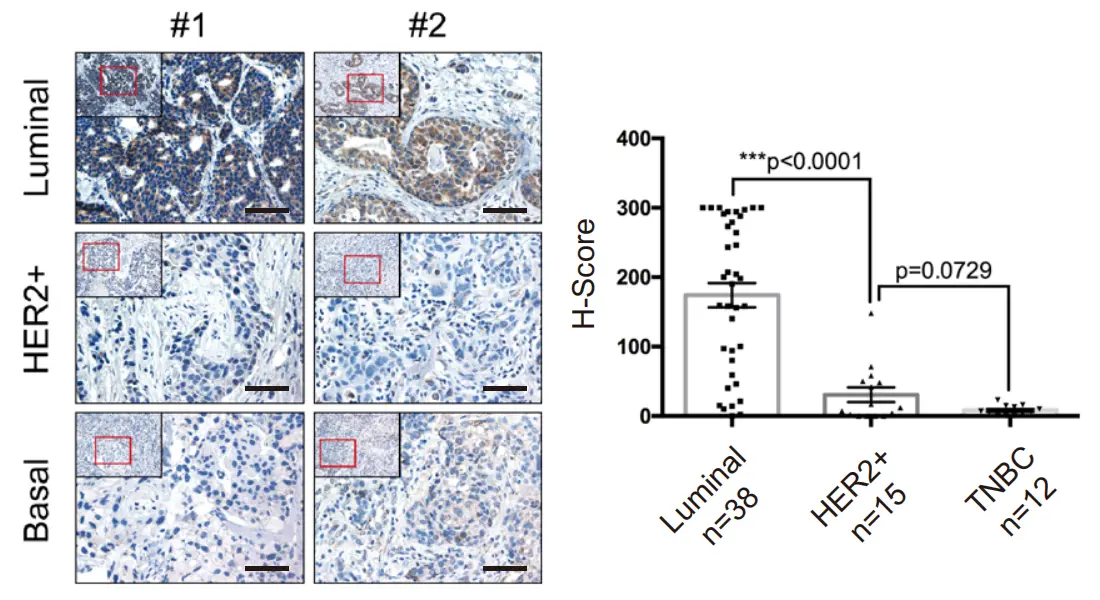
Figure 5. Immunohistochemical analysis of ASB10 protein expression in clinical breast cancer tissues.
Mechanistically, ERα binds to the ASB10 promoter and upregulates its transcription. Luminal tumors therefore express more ASB10, ensuring TEM8 degradation. By contrast, TNBC lacks ERα, so ASB10 expression is lost. As a result, TEM8 protein accumulates despite stable or even reduced mRNA levels.
This explains the protein–mRNA mismatch and highlights TEM8 as a functional biomarker and a potential therapeutic target for TNBC.
When transcriptomics and proteomics results diverge, the discrepancy often reflects biological regulation at the protein level. In TNBC, TEM8 accumulation results from reduced ubiquitination by ASB10, not from transcriptional changes.
This example illustrates how multi-omics integration—linking transcriptome, proteome, and post-translational modification analyses—can reveal hidden mechanisms and point toward new therapeutic strategies.
At Omics Empower, we provide end-to-end yeast hybrid screening services with extensive expertise in Gateway and SMART library construction, the GAL4 and ubiquitin systems, and both one-hybrid and two-hybrid assays.
Our platform has supported more than 200 peer-reviewed publications in journals such as Science and Cell, with a combined impact factor exceeding 1000. In collaboration with leading research institutions, we have developed plant transcription factor libraries (rice, Arabidopsis) and ubiquitin libraries that enable the discovery of novel protein–protein interactions and regulatory mechanisms. These resources help scientists worldwide accelerate progress in both biomedical and plant research.
Have a project in mind or questions about yeast hybrid screening? Get in touch with Omics Empower to discuss how we can support your research.
Germany: Arnold-Graffi-Haus / D85 Robert-Rössle-Straße 10 13125 Berlin
United States: (CA) 2 Goddard, Irvine, CA 92618
United States: (IL) 8255 Lemont Rd, #1, Darien, IL 60561
Hong Kong: Unit 615, Building 11W, Hong Kong Science Park, Pak Shek Kok, Hong Kong
Germany: Arnold-Graffi-Haus / D85 Robert-Rössle-Straße 10 13125 Berlin
United States: (CA) 2 Goddard, Irvine, CA 92618
United States: (IL) 8255 Lemont Rd, #1, Darien, IL 60561
Hong Kong: Unit 615, Building 11W, Hong Kong Science Park, Pak Shek Kok, Hong Kong
Germany: Arnold-Graffi-Haus / D85 Robert-Rössle-Straße 10 13125 Berlin
United States: (CA) 2 Goddard, Irvine, CA 92618
United States: (IL) 8255 Lemont Rd, #1, Darien, IL 60561
Hong Kong: Unit 615, Building 11W, Hong Kong Science Park, Pak Shek Kok, Hong Kong

 EN
EN
 de
de