Overview
The yeast two-hybrid (Y2H) system is a genetic method used to detect protein–protein interactions (PPIs) in living yeast cells. The assay relies on reconstituting a transcription factor when two proteins—designated as bait and prey—interact within the cell. The resulting activation of reporter genes provides a straightforward readout of interaction events.
Based on the subcellular localization of protein interaction, Y2H assays are generally classified into two types:
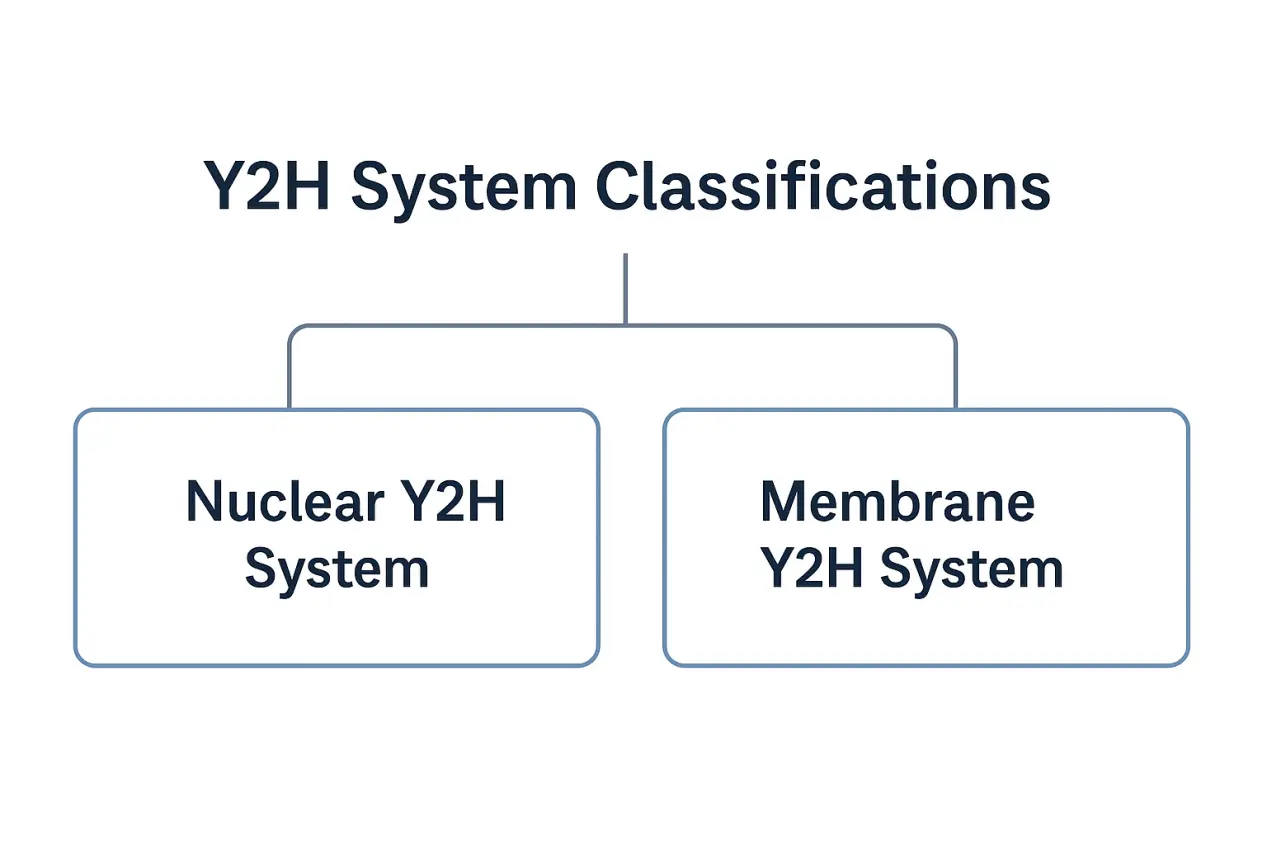
1. The Nuclear Y2H System (GAL4-Based)
Principle
The classical Y2H system was first established by Fields and Song (1989) using the transcription factor GAL4. In this system, the bait protein is fused to the DNA-binding domain (BD) of GAL4, and the prey protein is fused to the activation domain (AD).
When the bait and prey interact in the nucleus, the two domains of GAL4 are brought together, forming a functional transcription factor. This activates reporter genes such as HIS3, ADE2, or LacZ, allowing yeast growth on selective media or producing measurable β-galactosidase activity.
Applications
This nuclear system is suitable for soluble, nuclear, and cytoplasmic proteins. It is also applied in yeast one-hybrid (Y1H) assays to identify transcriptional regulators that bind specific promoters.
Commercial Systems
The nuclear Y2H system was first commercialized by Clontech (Takara), using its patented SMART™ technology and the vector pGADT7-REC. Subsequently, Invitrogen introduced a Gateway®-based Y2H platform (pDEST22), which improved cloning flexibility and library fidelity.
Key advantages include:
1. High-fidelity cDNA synthesis without PCR amplification during the second-strand synthesis step.
2. Restriction enzyme-free recombination cloning, preventing cDNA fragmentation.
3. Reduced formation of chimeric clones.
4. Efficient vector transfer, enabling the same cDNA library to be used for expression or functional assays.
These innovations make Gateway-compatible Y2H systems particularly effective for constructing high-quality cDNA libraries from small RNA quantities (as little as 1 µg total RNA).
2. The Membrane Y2H System (Split-Ubiquitin–Based)
Background
The traditional GAL4-based Y2H system is unsuitable for membrane proteins, because the interacting proteins must localize to the nucleus for transcriptional activation. To overcome this limitation, Stagljar et al. (1998) developed the split-ubiquitin Y2H system, which allows detection of interactions among membrane-associated or integral membrane proteins in their native cellular compartments.
Mechanism
Ubiquitin is a highly conserved 76–amino acid protein that can be divided into two separable fragments:
Wild-type Nub and Cub naturally reassemble; therefore, a mutated version, NubG (Ile13→Gly), is used to eliminate spontaneous binding.
When the bait–Cub and prey–NubG fusion proteins interact, NubG and Cub reconstitute a complete ubiquitin molecule, which is recognized by ubiquitin-specific proteases (UBPs). The UBPs cleave the fusion protein and release LexA–VP16, which translocates to the nucleus and activates the reporter genes HIS3, ADE2, and LacZ.
Interpretation:
No interaction: LexA–VP16 remains membrane-anchored, and reporter genes remain silent.
Interaction present: LexA–VP16 is released and initiates reporter transcription.
Applications
This system provides a reliable platform to study membrane protein interactions, receptor–ligand binding, or protein complexes in endomembrane systems, expanding the analytical range beyond what the nuclear Y2H can achieve.
3. Technological Development and Dual-System Libraries
Dualsystems Biotech was the first to commercialize the split-ubiquitin Y2H platform.
Building on this foundation, Omics Empower introduced the technology into the Asia market, integrating the strengths of Clontech, Invitrogen, and Dualsystems to create a dual Y2H library construction system.
Omics Empower independently optimized library vectors (pGADT7-DEST and pPR3-N-DEST) based on Gateway® recombination, enabling:
Simultaneous construction of nuclear and membrane yeast libraries from a single RNA source.
PCR-free, restriction enzyme–free cloning for high library fidelity.
Preservation in both plasmid and working-solution formats.
Continuous generation of secondary libraries from primary libraries—allowing near-unlimited screening rounds.
This dual construction strategy bridges soluble and membrane interactomes, supporting comprehensive protein network analysis within a single platform.
4. Comparison of Y2H Systems
| Feature | Nuclear Y2H (GAL4) | Membrane Y2H (Split-Ubiquitin) |
| Principle | Reconstitution of GAL4 transcription factor | Reconstitution of ubiquitin and LexA release |
| Interaction Site | Nucleus | Membrane or cytoplasm |
| Suitable Targets | Soluble / nuclear / cytoplasmic proteins | Membrane and membrane-associated proteins |
| Reporter Genes | HIS3, ADE2, LacZ | HIS3, ADE2, LacZ |
| Typical Vectors | pGADT7-REC, pDEST22 | pPR3-N, Cub–LexA–VP16 |
| Main Developers | Fields & Song; Clontech; Invitrogen | Stagljar et al.; Dualsystems; Omics Empower |
Conclusion
Both the GAL4 nuclear system and the split-ubiquitin membrane system are essential tools for dissecting protein–protein interactions in yeast.While the nuclear Y2H remains the standard for soluble proteins, the split-ubiquitin approach extends interaction analysis to membrane-bound proteins.
Why Choose Omics Empower yeast two-hybrid (Y2H) Service?
At Omics Empower, we provide end-to-end yeast hybrid solutions, including Yeast One-Hybrid (Y1H), Yeast Two-Hybrid (Y2H), and custom library construction and screening. Our platform enables researchers to systematically study DNA–protein interactions and protein–protein interactions, supporting discoveries in gene regulation and molecular biology.
As one of the earliest companies to commercialize yeast hybrid technologies in Asia, Omics Empower has been a pioneer in Y1H and Y2H services. We were among the first to master both Gateway and SMART library construction methods, and we apply multiple yeast hybrid systems, including GAL4 and ubiquitin-based platforms, to meet the diverse needs of global research partners.
Backed by more than a decade of expertise, our yeast library platform has already supported 200+ customer publications, including high-impact studies featured on the covers of Science and Cell. This track record demonstrates both the reliability of our data and the trust placed in our services by the scientific community.
Proven Quality
10+ years of yeast library expertise with 200+ customer publications, including Science and Cell cover papers.
Gateway and SMART construction methods to meet different project requirements.
Rigorous QC: 12 checkpoints and 7 sequencing rounds guarantee reliability.
High transformation efficiency (>10⁶ CFU), ensuring full representation.
Dedicated Support
Expert technical team: molecular biologists, bioinformatics specialists, and local account managers.
One year of free after-sales support, covering troubleshooting and data analysis.
Contact our team today to discuss your research needs and explore how our yeast library and screening services can help drive your next research.
Related Articles for Yeast Library Design
If you are planning a Yeast Library project, these related articles may help you better understand library construction strategies, variant design considerations, and screening approaches, helping you build a streamlined workflow aligned with your research goals:
l Why Build Your Own Yeast Library for Protein Interaction Studies?
l Yeast One-Hybrid (Y1H) Assay: Principles, Systems, and Applications
l When Protein and mRNA Levels Don't Match: What Next?
l Yeast Two-Hybrid (Y2H) vs. AP-MS: Comparing Protein Interaction Detection
 EN
EN
 de
de 







_Systems.webp "Yeast Two-Hybrid (Y2H) Systems: From GAL4 to Split-Ubiquitin Assays")