
Microorganisms play essential roles in human health, bioenergy production, and environmental remediation, with broad applications in biotechnology.
Bulk metatranscriptomic analysis reveals overall gene expression and metabolic activity in microbial communities, but its population-level averaging often masks key differences between subpopulations. In contrast, cell-to-cell heterogeneity within the same species is a critical adaptive mechanism that enables rapid responses to environmental changes.
To resolve this complexity, microbial single-cell RNA sequencing (scRNA-seq) has become an essential tool for studying transcriptional activity at single-cell resolution.
However, applying scRNA-seq to microorganisms remains technically challenging.
Omics Empower supports microbial single-cell projects through its collaboration with MobiDrop. The MobiNova®-100 high-throughput single-cell platform and MobiMicrobe workflow have been evaluated across more than ten Gram-negative and Gram-positive bacterial species, including Escherichia coli, Klebsiella pneumoniae, and Bacillus subtilis.
In the following sections, we outline the key technical barriers in microbial single-cell transcriptomics and how they have been systematically overcome.
Unlike mammalian cells, which are surrounded only by a plasma membrane, prokaryotic bacteria possess an additional rigid cell wall. Gram-negative bacteria have a relatively thin peptidoglycan layer, whereas Gram-positive bacteria contain a much thicker and more robust structure. These differences not only provide mechanical strength but also protect bacteria from harsh environmental conditions.
As a result, lysis methods designed for mammalian cells are insufficient for bacteria. In addition, structural differences between bacterial groups require optimized and species-adapted conditions. In single-cell transcriptomics workflows, maintaining cellular integrity is also critical to prevent RNA degradation and preserve biological signals.
A commonly used strategy involves fixation with 4% paraformaldehyde, followed by washing and enzymatic permeabilization using lysozyme. This approach stabilizes cellular structure and labile RNA molecules while enabling reagent penetration through the otherwise impermeable cell wall and membrane.
Compared with eukaryotic cells, bacteria contain extremely low RNA abundance—approximately 0.1 pg total RNA per cell, nearly two orders of magnitude lower than mammalian cells (~10 pg). Moreover, only ~5% of bacterial RNA corresponds to mRNA, while ~90% is rRNA and ~5% is tRNA.
Bacterial mRNA is also highly unstable, with half-lives often measured in minutes, making RNA preservation a critical step. Although fixation helps stabilize transcripts, another major limitation is that bacterial mRNA lacks poly(A) tails, preventing direct application of standard eukaryotic single-cell RNA-seq capture strategies.
To address this, enzymatic polyadenylation is typically performed prior to reverse transcription, enabling efficient cDNA synthesis and downstream sequencing.
Ribosomal RNA accounts for the majority of total bacterial RNA, severely limiting the detection of informative mRNA reads. Studies have shown that rRNA depletion significantly increases the proportion of mRNA captured in sequencing libraries.
Importantly, comparisons between rRNA-depleted and non-depleted libraries show highly consistent gene expression profiles (r = 0.94), indicating that the depletion process does not introduce significant bias.
In the MobiDrop system, rRNA removal increases usable data yield from approximately 15% to 85%, while reducing sequencing depth requirements from 100 G to 60 G, substantially improving efficiency and cost-effectiveness.
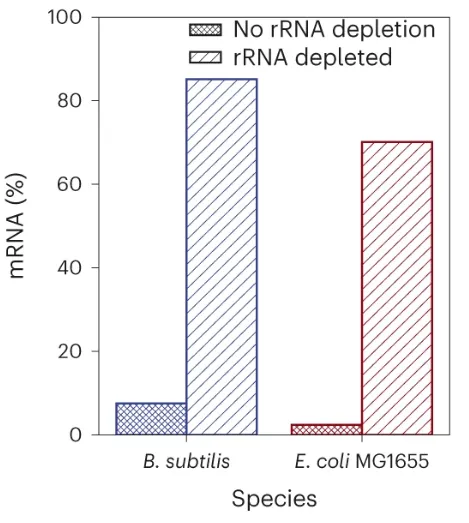
Figure 1. Proportion of mRNA reads in single-cell libraries of Bacillus subtilis and Escherichia coli before and after rRNA depletion.
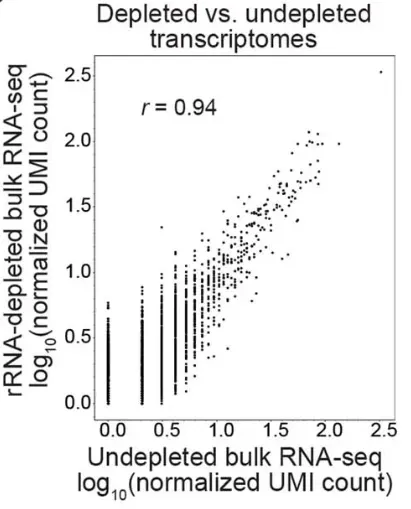
Figure 2. Comparison of gene-expression profiles between rRNA-depleted and non-depleted libraries (r = 0.94).
Bacterial single-cell transcriptomics is most effective when the workflow is treated as an integrated system. Excessive permeabilization can compromise RNA retention, insufficient permeabilization can limit molecular access, and poor rRNA management can reduce the value of otherwise well-prepared libraries.
With an appropriately optimized workflow, microbial single-cell RNA sequencing can reveal cell states and transcriptional programs that are obscured in bulk data. This can help researchers study microbial heterogeneity with greater resolution and connect individual-cell behaviour to broader biological function.
If you are planning a single-cell sequencing project, Omics Empower can support your research with professional single-cell sequencing services.
Researchers worldwide trust our data: more than 500 peer-reviewed publications have been generated using our single-cell and spatial transcriptomics services, including studies in Nature, Science, and Cell. From library preparation to bioinformatics and publication-ready figures, we deliver end-to-end support to help you advance your next single-cell project.
Comparing Single-Cell Sequencing Platforms: How to Choose the Right Fit for Your Study
A Complete Guide to Single-Nucleus RNA Sequencing (snRNA-seq)
10x Flex Single-Cell Sequencing FAQ
Understanding Single-Cell ATAC-Seq
How to Use Flow Cytometry (FACS) Effectively for Single-Cell Sequencing
Is Cell Subtype Annotation Necessary in Single-Cell RNA Sequencing?
Germany: Arnold-Graffi-Haus / D85 Robert-Rössle-Straße 10 13125 Berlin
United States: (CA) 2 Goddard, Irvine, CA 92618
United States: (IL) 8255 Lemont Rd, #1, Darien, IL 60561
Hong Kong: Unit 615, Building 11W, Hong Kong Science Park, Pak Shek Kok, Hong Kong
Germany: Arnold-Graffi-Haus / D85 Robert-Rössle-Straße 10 13125 Berlin
United States: (CA) 2 Goddard, Irvine, CA 92618
United States: (IL) 8255 Lemont Rd, #1, Darien, IL 60561
Hong Kong: Unit 615, Building 11W, Hong Kong Science Park, Pak Shek Kok, Hong Kong
Germany: Arnold-Graffi-Haus / D85 Robert-Rössle-Straße 10 13125 Berlin
United States: (CA) 2 Goddard, Irvine, CA 92618
United States: (IL) 8255 Lemont Rd, #1, Darien, IL 60561
Hong Kong: Unit 615, Building 11W, Hong Kong Science Park, Pak Shek Kok, Hong Kong

 EN
EN
 de
de