
Plant single-cell RNA sequencing is becoming an important tool for studying cell identity, development, stress responses, and tissue organization in plant research. However, sample preparation remains a major limitation. Because plant cells have rigid cell walls, many tissues are difficult to dissociate into intact, high-quality protoplasts, especially mature, lignified, field-collected, or cryopreserved samples.
A recent Nature Methods study introduced FX-Cell and its derivative workflows, FXcryo-Cell and cryoFX-Cell, to expand plant scRNA-seq to difficult-to-digest and cryopreserved samples. These workflows provide new options for researchers working with challenging plant materials.
This article explains how FX-Cell works, when it is useful, and how it can complement plant single-nucleus RNA-seq for more robust experimental design.
*Omics Empower is the exclusive authorized service provider for FX-Cell technology.
Single-cell RNA sequencing in plants typically requires the isolation of high-quality protoplasts. This step is technically demanding because plant cell walls vary widely across species, tissues, developmental stages, and environmental conditions.
Common challenges include:
Low protoplast yield from mature or lignified tissues
Cell-type bias introduced during enzymatic digestion
Stress-response gene activation during prolonged sample processing
RNA degradation caused by RNase contamination or harsh dissociation conditions
Limited feasibility for field-collected or frozen plant samples
These limitations can affect cell recovery, gene detection, and the biological interpretation of downstream single-cell data. For researchers studying complex plant tissues, rare cell states, stress responses, or non-model species, sample preparation is often the key factor that determines whether a plant single-cell project is feasible.
FX-Cell is a fixation-based plant single-cell RNA-seq sample preparation method designed to improve cell recovery from difficult-to-digest plant tissues. Instead of relying only on conventional protoplast isolation, FX-Cell introduces fixation before enzymatic digestion, helping stabilize cell structure and preserve the transcriptomic state before sample processing.
The method is supported by three main technical features:
FX-Cell fixes plant tissues before enzymatic digestion. This helps stabilize cellular structures and reduces transcriptional changes that may be introduced during prolonged protoplast preparation.
For studies of acute stress responses, this is especially important. If tissue processing itself induces wound-response or stress-response genes, the resulting dataset may reflect technical artifacts rather than the true biological condition. By fixing the sample earlier in the workflow, FX-Cell helps preserve the transcriptional state closer to the moment of collection.
FX-Cell uses optimized enzymatic digestion conditions to improve the release of cells from tissues with rigid or specialized cell walls. Compared with conventional digestion workflows, this can improve recovery from tissues that are otherwise difficult to dissociate.
This is particularly relevant for plant structures such as tillering nodes, rhizomes, reproductive tissues, and other materials where standard protoplast isolation may produce low yield or biased cell representation.
Plant sample dissociation can expose RNA to degradation, especially when enzymes or tissue extracts contain RNases. FX-Cell includes RNA protection measures during the dissociation process to help maintain RNA quality for downstream single-cell sequencing.
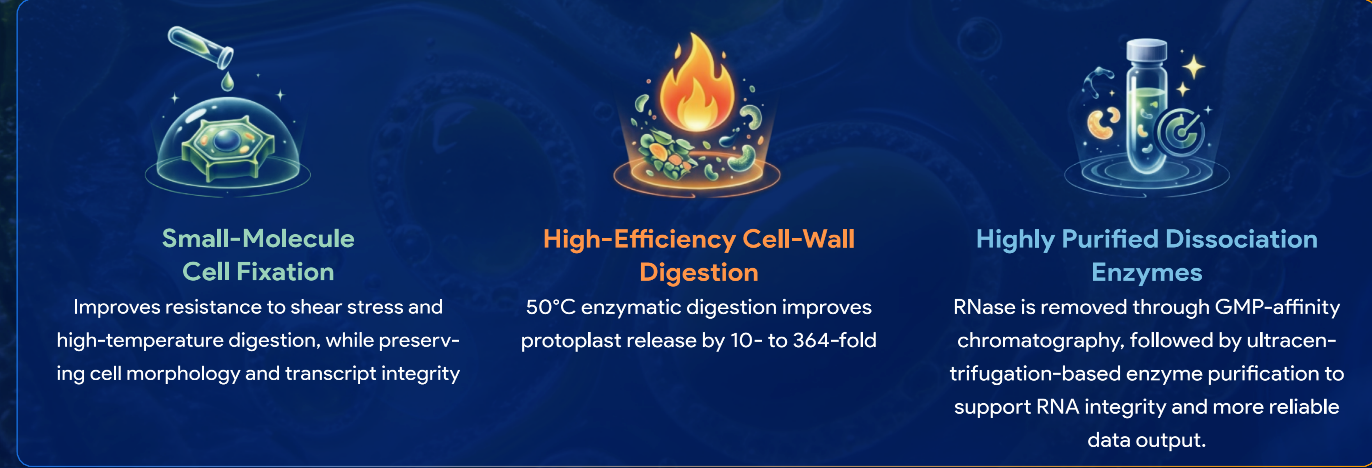
Together, these features make FX-Cell a useful option for plant scRNA-seq projects where standard protoplast preparation is difficult, unstable, or likely to introduce bias.
FX-Cell is not a single fixed workflow for all sample types. The platform includes related workflows that support different sample collection and storage conditions.
Workflow | Best For | Key Advantage |
FX-Cell | Fresh or freshly fixed difficult plant tissues | Improves cell release while preserving transcriptomic state |
FXcryo-Cell | Samples that can be fixed first and stored frozen | Supports delayed processing and batch collection |
cryoFX-Cell | Samples frozen immediately after collection | Enables analysis of field-collected or archived frozen materials |
In practice, the choice depends mainly on when the sample can be fixed and whether immediate processing is possible. FX-Cell is suitable for fresh or freshly fixed tissues. FXcryo-Cell is useful when samples can be fixed first but need to be stored before sequencing. cryoFX-Cell is useful when samples must be frozen immediately after collection, such as during fieldwork or when working with valuable plant materials that cannot be processed on site.
This flexibility is one of the key advantages of the FX-Cell workflow family. It expands plant scRNA-seq beyond ideal laboratory samples and makes it more practical for real-world plant research settings.
Plant single-nucleus RNA sequencing has become an important alternative for samples where intact protoplast isolation is difficult. Instead of isolating whole cells, snRNA-seq profiles nuclei extracted from plant tissues. This makes it useful for mature, thick-walled, lignified, or structurally rigid tissues.
FX-Cell and snRNA-seq should not be viewed as direct replacements for each other. They answer partially different technical and biological questions.
FX-Cell is designed to improve whole-cell recovery for plant scRNA-seq. It is especially useful when researchers want to preserve cell-level transcriptomic information and capture cytoplasmic mRNA from challenging tissues.
snRNA-seq, by contrast, can be more suitable when whole-cell isolation remains difficult or when researchers are working with mature tissues, archived materials, or nuclear multi-omics workflows such as snATAC-seq.
Research Need | Recommended Approach |
Difficult-to-dissociate plant tissues | FX-Cell |
Field-collected or cryopreserved samples | FXcryo-Cell / cryoFX-Cell |
Mature, thick-walled, or highly lignified cells | snRNA-seq |
Acute stress-response studies | FX-Cell |
Multi-omics integration, such as snRNA-seq + snATAC-seq | snRNA-seq |
Comprehensive plant cell atlas construction | FX-Cell + snRNA-seq |
For many plant projects, the most reliable strategy is not to choose one method blindly, but to match the workflow to the tissue type, research question, and sample logistics.
FX-Cell may be particularly useful for plant single-cell projects involving:
Many plant tissues contain specialized or rigid cell walls that make standard protoplast isolation inefficient. FX-Cell can help improve cell recovery from challenging tissues where conventional dissociation produces low yield or biased cell populations.
For field-grown crops or ecological samples, immediate protoplast preparation is often not possible. FXcryo-Cell and cryoFX-Cell provide more flexible options for sample collection, storage, and later processing.
Cryopreservation can make plant single-cell workflows more practical for multi-site studies, seasonal sampling, and valuable biological materials. The FX-Cell derivative workflows support plant scRNA-seq from frozen or previously stored samples, depending on how the sample was preserved.
Plant stress responses can change quickly during sample handling. For studies involving wounding, environmental stress, pathogen response, or developmental transitions, early fixation may help reduce processing-induced transcriptional artifacts.
For cell atlas construction, broad and representative cell recovery is essential. FX-Cell can be used as a primary workflow for difficult tissues, while snRNA-seq can be added to capture cell types that are better represented at the nuclear level.
For complex plant studies, FX-Cell and snRNA-seq can be combined strategically. Below are three practical ways to design a project.
Strategy 1 | Strategy 2 | Strategy 3 | |
Technology Strategy | FX-Cell as the primary platform, snRNA-seq as a complementary approach | snRNA-seq as the primary platform, FX-Cell for validation | Integrated dual-platform analysis |
Applicable Scenarios | High-resolution cell atlas construction, acute stress response studies, profiling of the majority of cell types | Highly lignified tissues, integrative multi-omics studies (e.g., snATAC-seq), high-throughput screening projects | Comprehensive cell atlas construction of complex tissues, multidimensional analysis of developmental trajectories |
Research Rationale | FX-Cell provides high gene-detection sensitivity as the core dataset, while snRNA-seq complements transcriptional information from thick-walled or difficult-to-isolate cell types. | snRNA-seq offers broad cell-type coverage, while FX-Cell is used to validate gene expression patterns in key or hard-to-dissociate cell populations. | The two technologies capture distinct cellular populations across developmental stages. When integrated with spatial transcriptomics, they enable reconstruction of a complete and high-resolution developmental landscape. |
Omics Empower is the exclusive authorized service provider for FX-Cell technology. We offer FX-Cell-based plant single-cell RNA-seq services , with support from sample feasibility review to sequencing and bioinformatics analysis.
Our team can help you select the most suitable workflow, including FX-Cell, FXcryo-Cell, cryoFX-Cell, or plant snRNA-seq, based on your plant species, tissue type, sample condition, and research goals.
We also provide guidance on sample fixation, freezing, shipping, batch planning, library preparation, sequencing quality control, and downstream analysis such as clustering, marker gene identification, cell-type annotation, trajectory analysis, and publication-ready visualization.
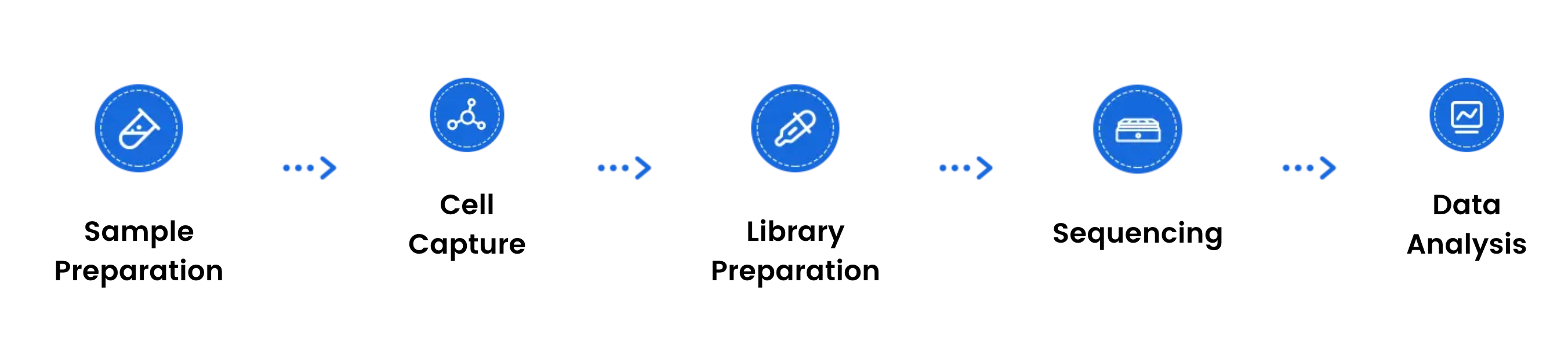
If you are planning a plant single-cell RNA-seq, plant snRNA-seq, or integrated single-cell and spatial transcriptomics project, Omics Empower can help you assess sample feasibility and select a suitable workflow. Contact our team to discuss your plant species, tissue type, sample collection plan, and research objectives.
Researchers worldwide trust our data: more than 500 peer-reviewed publications have been generated using our single-cell and spatial transcriptomics services, including studies in Nature, Science, and Cell. From library preparation to bioinformatics and publication-ready figures, we deliver end-to-end support to help you advance your next single-cell project.
A Complete Guide to Single-Nucleus RNA Sequencing (snRNA-seq)
Is Cell Subtype Annotation Necessary in Single-Cell RNA Sequencing?
Cross-Species Cell Type Annotation for Plant scRNA-seq with the OMG Browser
Ming X, Wan MC, Zhang ZD, et al. FX-Cell: a method for single-cell RNA sequencing on difficult-to-digest and cryopreserved plant samples. Nature Methods. 2025;22:2551-2562. doi:10.1038/s41592-025-02900-2.
Germany: Arnold-Graffi-Haus / D85 Robert-Rössle-Straße 10 13125 Berlin
United States: (CA) 2 Goddard, Irvine, CA 92618
United States: (IL) 8255 Lemont Rd, #1, Darien, IL 60561
Hong Kong: Unit 615, Building 11W, Hong Kong Science Park, Pak Shek Kok, Hong Kong
Germany: Arnold-Graffi-Haus / D85 Robert-Rössle-Straße 10 13125 Berlin
United States: (CA) 2 Goddard, Irvine, CA 92618
United States: (IL) 8255 Lemont Rd, #1, Darien, IL 60561
Hong Kong: Unit 615, Building 11W, Hong Kong Science Park, Pak Shek Kok, Hong Kong
Germany: Arnold-Graffi-Haus / D85 Robert-Rössle-Straße 10 13125 Berlin
United States: (CA) 2 Goddard, Irvine, CA 92618
United States: (IL) 8255 Lemont Rd, #1, Darien, IL 60561
Hong Kong: Unit 615, Building 11W, Hong Kong Science Park, Pak Shek Kok, Hong Kong

 EN
EN
 de
de