
Spatial transcriptomics has changed how researchers study tissue biology. Instead of measuring gene expression after cells have been dissociated from their native environment, spatial technologies allow transcriptomic data to be read together with tissue architecture.
But for many biological questions, spatial context is not limited to a small region of interest. A tumor section may include a necrotic core, invasive margin, stromal interface, and immune-enriched regions. A developing embryo may require simultaneous observation of multiple organs. A brain atlas may depend on preserving long-range anatomical relationships across serial sections.
In these settings, researchers often face a technical trade-off: high resolution with a limited field of view, or larger tissue coverage with lower spatial detail. Traditional multi-chip or multi-section stitching can help extend coverage, but it also introduces alignment complexity, batch variation, edge effects, and potential discontinuity in spatial information.
Stereo-seq large-format chips are designed to address this problem by combining a broad capture area with high-resolution spatial transcriptomic profiling. For studies that require both tissue-scale context and near-cellular or subcellular spatial precision, this combination can be especially valuable.
*Omics Empower is a certified Stereo-seq service provider, supporting spatial transcriptomics projects from sample preparation and sequencing to bioinformatics analysis.
In complex tissues, biological interpretation depends heavily on context. A small field of view may capture interesting local interactions, but it can miss the larger anatomical gradients, tissue boundaries, and multi-region relationships that explain why those interactions occur.
Large-format spatial transcriptomics enables researchers to analyze broader tissue areas in a single experimental context. This is particularly important for samples with strong regional organization, such as embryos, brain sections, large organs, tumor resections, and plant or animal tissues with irregular morphology.
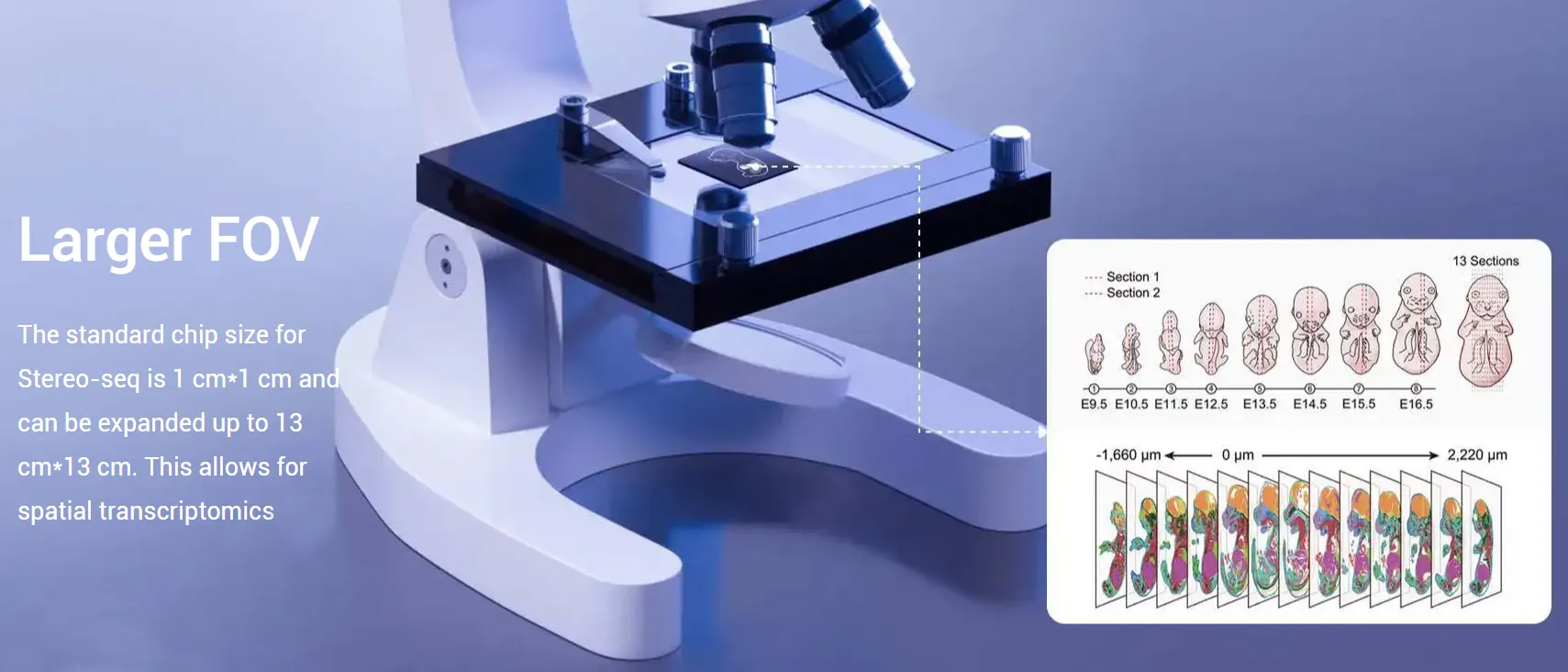
Instead of treating tissue as a series of disconnected regions, a larger field of view allows researchers to observe how molecular programs are distributed across anatomical structures. This can help reveal gradients, transitional zones, developmental boundaries, and spatially coordinated cell states that might be missed in a smaller region.
When multiple small capture areas are combined, the final spatial map depends on image registration, section-to-section alignment, and computational stitching. Even when these steps are performed carefully, they can introduce technical variability or make it harder to distinguish biological differences from processing effects.
A larger capture area reduces the need to stitch many small datasets together. This helps preserve spatial continuity and can make downstream interpretation more straightforward, especially in studies where tissue boundaries, gradients, or long-range relationships are central to the research question.
A larger field of view is only useful if important cellular details remain visible. Stereo-seq is built on DNA nanoball-patterned array technology and achieves a reported 500 nm spatial resolution, allowing researchers to map gene expression with high spatial precision across a broad tissue area.
This is the key value proposition of large-format Stereo-seq: it does not simply capture more tissue. It helps researchers capture more tissue while retaining the spatial detail needed for cell-type localization, tissue-domain detection, and cell-neighborhood analysis.
Stereo-seq large-format chips are useful because they address three practical bottlenecks in spatial transcriptomics: field of view, resolution, and sample flexibility.
Stereo-seq large-format chips can expand the capture area beyond the standard 1 cm × 1 cm format, supporting projects that require broader tissue coverage. This makes the technology well suited for large sections, serial-section atlases, and whole-organ or multi-region studies.
Unlike targeted in situ panels, Stereo-seq is designed for spatial transcriptomic profiling across the transcriptome. This can be useful for discovery-driven studies where researchers do not yet know which genes, pathways, or cell states will be most important.
Large or irregular samples are common in developmental biology, neuroscience, cancer research, animal models, and plant studies. Customizable chip formats can help researchers design experiments around the actual geometry of the sample rather than forcing the sample into a small predefined capture area.
The scientific value of large-format spatial transcriptomics is best illustrated by studies where tissue-scale context and high-resolution spatial information were both required.
A landmark Cell study used Stereo-seq to generate a spatiotemporal transcriptomic atlas of mouse organogenesis. By combining spatially resolved transcriptomics with single-cell analysis, the study reconstructed developmental dynamics across mid-to-late embryonic stages and linked gene expression programs to anatomical structures.
The value of large-format spatial profiling is clear in this type of study. Organogenesis is not a local event. Cells differentiate, migrate, and interact across multiple developing tissues. A broad field of view helps preserve these relationships and supports the construction of 3D developmental maps.
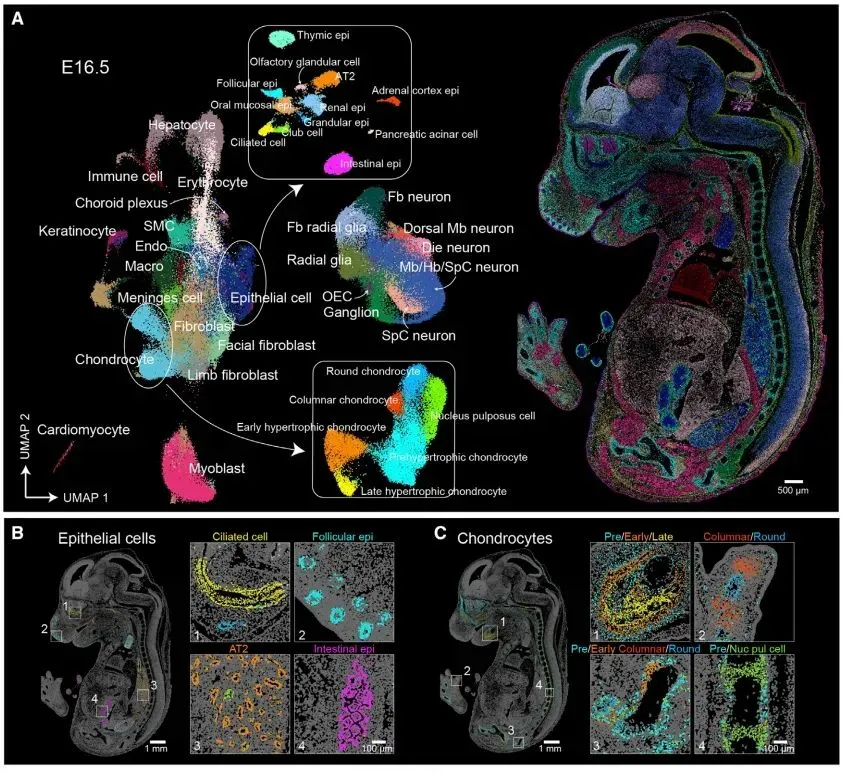
Image adapted from Chen A., Liao S., Cheng M., et al., Cell, 2022.
Another Cell study used Stereo-seq to map cell-type organization in the macaque cortex. By integrating single-cell transcriptomic data with spatial transcriptomics across serial brain sections, researchers generated a spatial view of cortical cell-type distribution at large scale.
For primate brain research, this matters because the cortex contains layered, regional, and long-range organization. A large field of view makes it possible to study cell types not only as isolated clusters, but as spatially organized populations within anatomical structures.
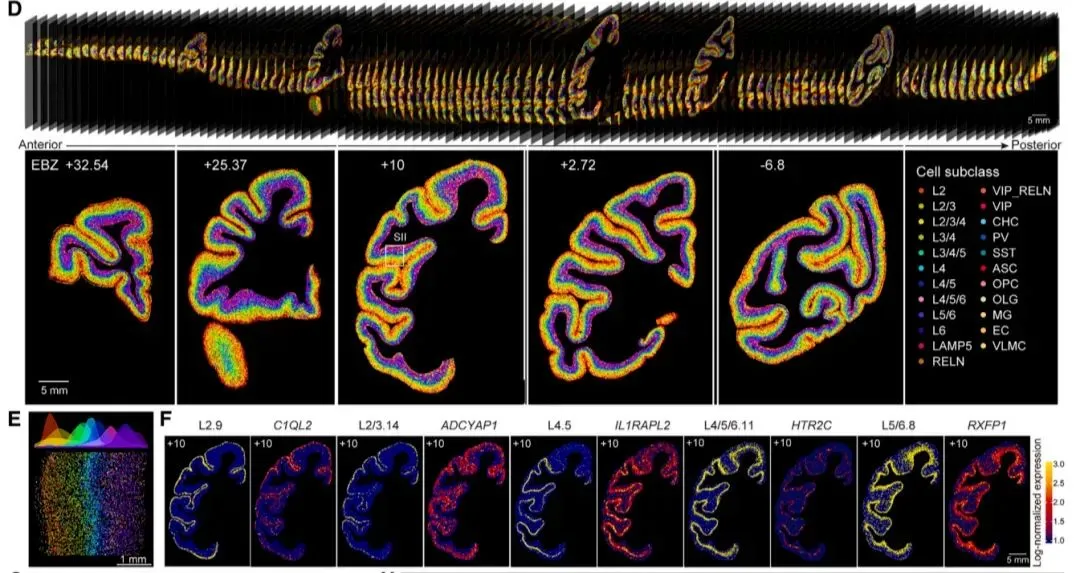
Image adapted from Chen A., Sun Y., Lei Y., et al., Cell, 2023.
A 2023 Cell study combined spatial transcriptomics and single-cell RNA sequencing to build a spatiotemporal atlas of multiple human brain regions from gestational week 6 to week 23. This type of work requires both developmental time-series sampling and spatial mapping across multiple anatomical regions.
Large-format chips help researchers preserve the structure of developing brain regions while comparing spatial gene-expression patterns across time. This supports the discovery of region-specific cell states, developmental gradients, and regulatory programs that may not be evident from dissociated single-cell data alone.
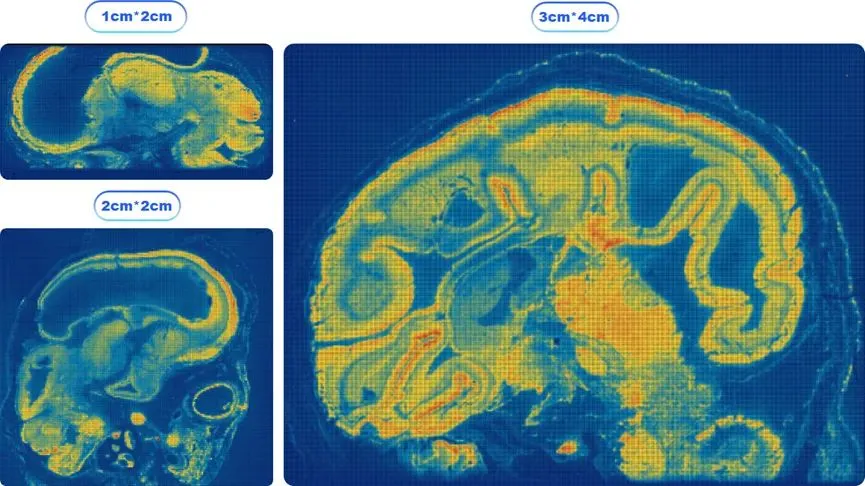
Image adapted from Li Y., et al., Cell, 2023.
In 2026, Nature Communications published a high-resolution spatial atlas of human fetal and pediatric thymus using Stereo-seq spatial transcriptomics. The study mapped thymic architecture and helped characterize rare mimetic thymic epithelial cells within their spatial microenvironment.
This example highlights an important advantage of high-resolution spatial profiling: rare cell populations are not only defined by marker genes. Their location, neighboring cells, and tissue niches are often essential for understanding their biological role.
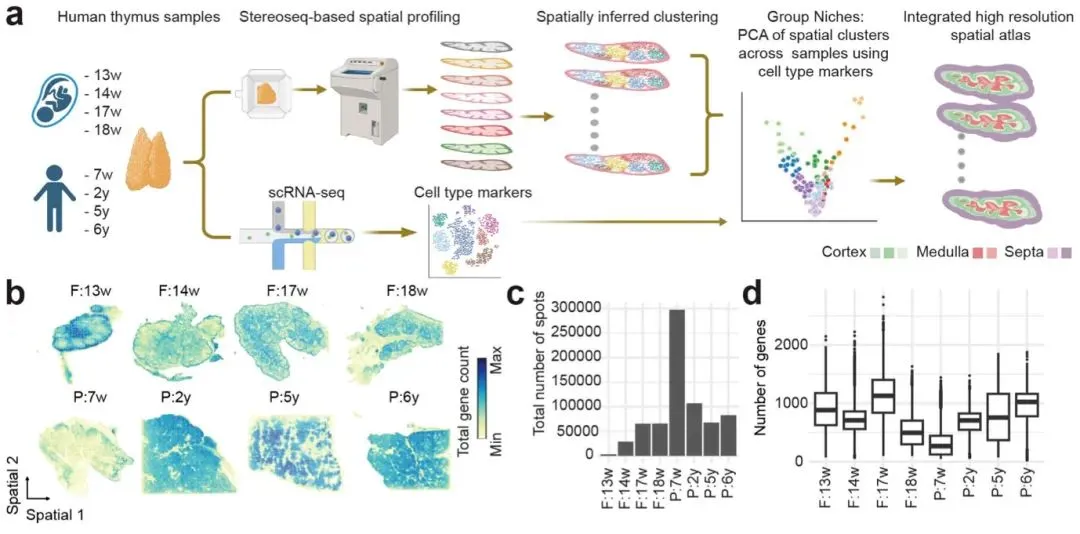
Image adapted from Kamaraj U.S., Chen Y., Lei J., et al., Nature Communications, 2026.
Stereo-seq large-format spatial transcriptomics may be particularly appropriate when a project requires one or more of the following:
Large tissue coverage or whole-section analysis
High-resolution mapping of cell types or spatial domains
Discovery-driven transcriptomic profiling rather than a predefined targeted panel
3D atlas construction from serial sections
Comparison of multiple anatomical regions within the same tissue context
Studies involving large, irregular, or non-standard sample morphology
For projects focused on a defined gene panel, highly multiplexed in situ imaging, or specific FFPE workflows, other spatial platforms may also be appropriate. The best choice depends on sample type, tissue size, RNA quality, research question, desired resolution, and downstream analysis goals.
As a service provider offering Stereo-seq spatial transcriptomics, Omics Empower provides comprehensive support throughout the entire workflow:

We offer an end-to-end Stereo-seq workflow—from sample preparation and chip selection to library construction, sequencing, and data analysis—so you can focus on the scientific questions. Our teams in Asia, Europe, and North America provide coordinated project support and reliable turnaround times for researchers worldwide.
We have been delivering single-cell and spatial multi-omics services since 2018. Our collaborators have published 500+ papers in single-cell sequencing and spatial transcriptomics, including studies in high-impact journals such as Nature, Cell, and Science.
If you are planning a Stereo-seq project, feel free to contact us with your sample type, tissue size, species, and research goal. Our team would be happy to help assess feasibility and recommend a suitable workflow.
1. Chen A., Liao S., Cheng M., et al. Spatiotemporal transcriptomic atlas of mouse organogenesis using DNA nanoball-patterned arrays. Cell. 2022;185(10):1777–1792.e21.
2. Chen A., Sun Y., Lei Y., et al. Single-cell spatial transcriptome reveals cell-type organization in the macaque cortex. Cell. 2023;186(17):3726–3743.e24.
3. Li Y., et al. Spatiotemporal transcriptome atlas reveals the regional specification of the developing human brain. Cell. 2023.
4. Kamaraj U.S., Chen Y., Lei J., et al. Spatial cartography of human thymus enables the geopositioning of lineage transcription factors in rare mimetic thymic epithelial cells. Nature Communications. 2026;17:3721.
Related Articles for Spatial Transcriptomics
If you are comparing spatial transcriptomics technologies for your next study, these related articles may help you better understand platform differences, workflow considerations, and application scenarios:
Stereo-seq S0.5 Explained: A High-Resolution Option for Small Spatial Samples
Xenium Applications: 3 Research Examples in Cancer, Neuroinflammation, and Development
Sample Preparation Guide for Visium HD Spatial Transcriptomics
Germany: Arnold-Graffi-Haus / D85 Robert-Rössle-Straße 10 13125 Berlin
United States: (CA) 2 Goddard, Irvine, CA 92618
United States: (IL) 8255 Lemont Rd, #1, Darien, IL 60561
Hong Kong: Unit 615, Building 11W, Hong Kong Science Park, Pak Shek Kok, Hong Kong
Germany: Arnold-Graffi-Haus / D85 Robert-Rössle-Straße 10 13125 Berlin
United States: (CA) 2 Goddard, Irvine, CA 92618
United States: (IL) 8255 Lemont Rd, #1, Darien, IL 60561
Hong Kong: Unit 615, Building 11W, Hong Kong Science Park, Pak Shek Kok, Hong Kong
Germany: Arnold-Graffi-Haus / D85 Robert-Rössle-Straße 10 13125 Berlin
United States: (CA) 2 Goddard, Irvine, CA 92618
United States: (IL) 8255 Lemont Rd, #1, Darien, IL 60561
Hong Kong: Unit 615, Building 11W, Hong Kong Science Park, Pak Shek Kok, Hong Kong

 EN
EN
 de
de