EN
EN
 de
de 







Recommended depth depends on tissue type, capture area, and study goals. Our team provides project-specific guidance.


Omics Empower provides Stereo-seq spatial transcriptomics services as a global CRO, supporting research projects with local laboratory operations in Europe, Hong Kong, and the United States. Our end-to-end Stereo-seq workflow enables high-resolution spatial profiling from focused tissue regions to large-area sections, delivering reliable data for biological discovery and translational research.
Our Stereo-seq OMNI (FFPE) data quality has been officially recognized by STOmics at the highest level—see our news update for details.
Stereo-seq is a spatial transcriptomics technology based on DNA Nanoball (DNB) arrays. It combines high throughput, sub-micron resolution (~500 nm), and large field of view to capture gene expression across tissue, cellular, and subcellular scales in the same sample.
In Stereo-seq, tissue sections are placed on a patterned chip where mRNA is captured by spatial barcodes (Coordinate IDs, CIDs). These barcodes record the exact location of each transcript. After library preparation and sequencing, the data are reconstructed into spatial gene expression maps, enabling researchers to study how cells interact with their local environment.
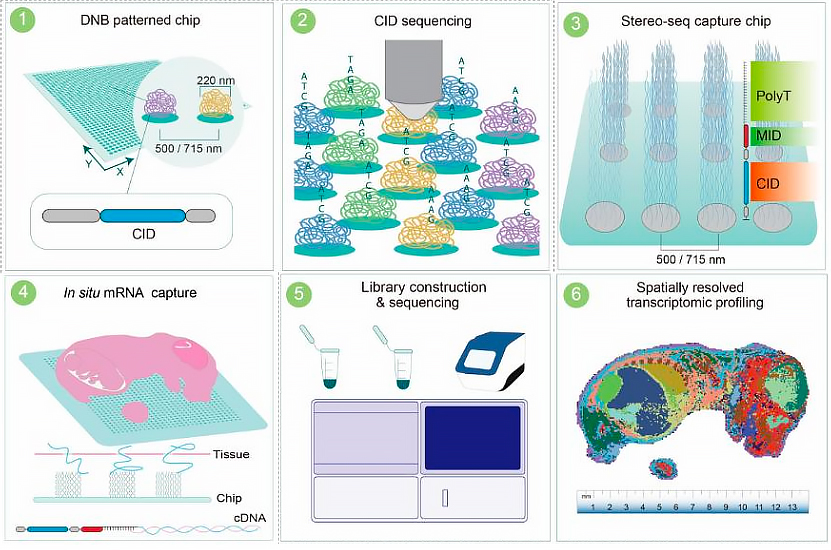
Stereo-seq Workflow Overview
High spatial resolution: Stereo-seq chips have a very dense arrangement of spots, with adjacent coordinates spaced at ~500 nm. Given that an average mammalian cell is about 10 µm in diameter, each cell corresponds to hundreds of capture spots. This enables sub-cellular resolution, which is beyond what most other spatial transcriptomics platforms currently offer.
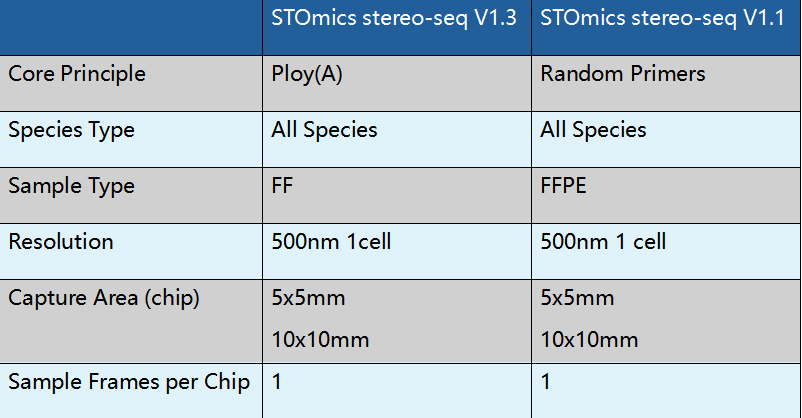
Large capture area: Standard chips cover areas such as 1 × 1 cm or 0.5 × 0.5 cm, and larger custom formats are available (e.g., 2 × 3 cm, 5 × 5 cm). The maximum chip size can reach up to 13 × 13 cm, allowing analysis from small tissue regions to near-whole-organ scales.
Higher gene capture per area: Comparative studies show that, for the same physical area, Stereo-seq captures more unique molecular identifiers (UMIs) per unit area than many other platforms — enabling richer gene expression profiles from each section.
Resolve spatial differences within tumors and surrounding tissues to study heterogeneity and local cellular organization.

Map immune cell localization within tissues to understand spatially regulated immune responses.

Examine spatial gene expression patterns across brain regions and neural structures.

Track spatial gene expression changes during tissue and organ formation.
Extensive experience in single-cell and spatial transcriptomics, with a global network of laboratories and PhD-level technical support.
Successfully conducted 17,000+ single-cell experiments across 2,000+ tissue types.
Contributed to 370+ scientific publications, widely recognized in single-cell and spatial transcriptomics.
Client trust and satisfaction are our top priorities, serving as the key measure of our success.
We actively engage with researchers, offering customized sequencing solutions tailored to their specific needs.
Diverse single-cell and spatial sequencing solutions tailored to various research needs.
Strong partnerships with top-tier omics platforms, ensuring access to cutting-edge technologies.
Capable of handling projects of all scales, from pilot studies to large-scale research initiatives.
Not sure which spatial transcriptomics technology best fits your study?
We provide practical guidance comparing Stereo-seq, Visium, Xenium, and other leading platforms to help researchers make informed decisions based on resolution, capture area, sample type, and research objectives.
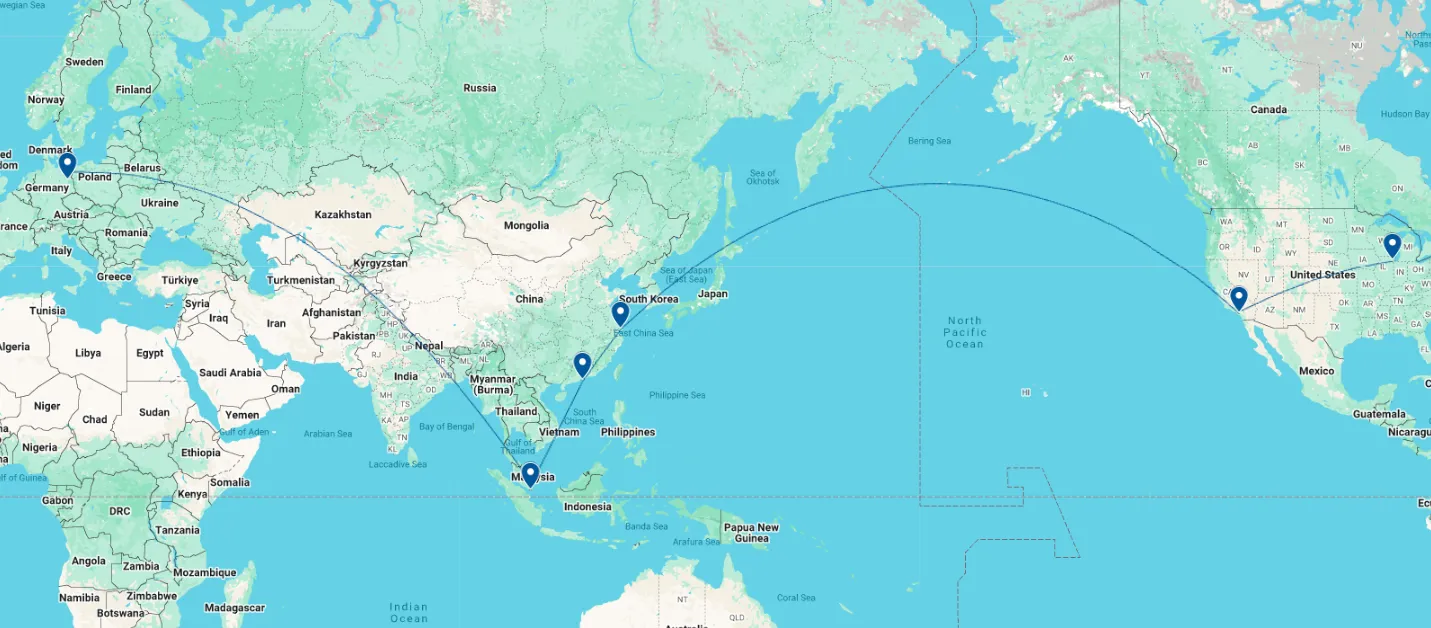
With lab operations in the U.S., Europe, and Asia, we provide responsive support for international projects and multi-site studies. Coordinated logistics ensure timely delivery and sample stability—no matter where your research takes place.
Recommended depth depends on tissue type, capture area, and study goals. Our team provides project-specific guidance.
Germany: Arnold-Graffi-Haus / D85 Robert-Rössle-Straße 10 13125 Berlin
United States: (CA) 2 Goddard, Irvine, CA 92618
United States: (IL) 8255 Lemont Rd, #1, Darien, IL 60561
Hong Kong: Room 618, Building 6, Hong Kong Science Park, Pak Shek Kok, Hong Kong
Germany: Arnold-Graffi-Haus / D85 Robert-Rössle-Straße 10 13125 Berlin
United States: (CA) 2 Goddard, Irvine, CA 92618
United States: (IL) 8255 Lemont Rd, #1, Darien, IL 60561
Hong Kong: Room 618, Building 6, Hong Kong Science Park, Pak Shek Kok, Hong Kong
Germany: Arnold-Graffi-Haus / D85 Robert-Rössle-Straße 10 13125 Berlin
United States: (CA) 2 Goddard, Irvine, CA 92618
United States: (IL) 8255 Lemont Rd, #1, Darien, IL 60561
Hong Kong: Room 618, Building 6, Hong Kong Science Park, Pak Shek Kok, Hong Kong