EN
EN
 de
de 





10x Flex supports fresh, frozen, and FFPE human or mouse samples. Omics Empower provides global 10x Genomics Flex sequencing services with laboratories in Hong Kong, Germany, and the U.S., covering complete workflows from sample QC to sequencing.


The 10x Genomics Single Cell Gene Expression Flex (often called 10x Flex) was launched to make single-cell transcriptome profiling more accessible and sample-friendly.
Unlike traditional 3′ or 5′ scRNA-seq that require fresh cell suspensions, Flex enables researchers to preserve, store, and process samples at different time points without compromising RNA quality.
By combining probe-based chemistry with cell fixation, Flex allows more flexibility for human and mouse samples, including fresh, frozen, and FFPE materials.
Below, we’ve summarized common questions from researchers when planning Flex projects — from sample preparation and pooling to probe design and data quality.
Flex can be applied to fresh or frozen human and mouse tissues, cell suspensions, and FFPE blocks.
For fresh tissue, samples can be shipped in a tissue preservation buffer, dissociated into single-cell suspensions, then fixed and stored.
Alternatively, samples can be snap-frozen in liquid nitrogen and shipped on dry ice — a better option for tissues rich in RNases.
To maintain data comparability across batches, all samples from the same study should follow identical collection, fixation, and shipping procedures.
For FFPE samples, it’s best to send paraffin blocks.
If only slides are available, ensure at least two 25 µm scrolls for human samples or four for mouse (stored in 1.5 ml tubes, sealed, and shipped at 4 °C).
Currently, there’s no universal QC metric to predict FFPE performance in Flex experiments.
Experience shows that samples performing well in Visium CytAssist FFPE workflows generally yield good Flex results too.
For untested FFPE tissues, it’s strongly recommended to run a pilot test on a small portion before committing to a large-scale study.
Advantages
Cell state preservation: fixation locks transcriptomic states immediately, providing stable and reproducible profiles.
Batch flexibility: fixed samples from different time points can be processed together, minimizing batch effects.
Cost efficiency: multiple samples can be pooled and sequenced together, lowering per-sample cost.
FFPE compatibility: expands access to archival tissues and enables integration with CytAssist spatial transcriptomics for deeper analysis.
Limitations
Species restriction: probe sets are available only for human and mouse.
Gene coverage: only genes with corresponding probes are detected — novel or uncovered transcripts cannot be profiled.
Flex follows similar size limits to standard 10x Chromium workflows.
Cells up to 30 µm in diameter perform reliably; larger cells may clog microfluidic chips.
For oversized cell types, using isolated nuclei is recommended.
Pooling is possible but must be carefully designed.
In a pooled library, sequencing reads distribute in proportion to RNA content, not cell number.
High-RNA samples will dominate reads, while low-RNA samples receive fewer.
If additional sequencing is needed to balance one sample, all samples in the pool must be re-sequenced, increasing cost.
Therefore, pool only samples with comparable RNA content whenever possible.
The human transcriptome probe set covers 18 082 genes (53 444 probes), and the mouse set covers 19 059 genes (55 128 probes).
Roughly 90 % of genes are covered by three probe pairs, while highly expressed housekeeping or mitochondrial genes use one pair, and low-abundance genes may be targeted by up to five pairs to enhance detection sensitivity.
Flex probes are not species-specific.
In PDX samples, where human and mouse transcripts coexist, cross-hybridization may occur.
Typically, researchers focus on human cells and treat mouse RNA as background.
You can use the human transcriptome probe set and restrict downstream analysis to human genes.
During clustering, mouse-derived cells may form separate clusters identifiable by marker genes.
For 4-sample pooling, up to 66 000 cells/nuclei per well can be loaded, yielding about 40 000 captured cells.
Each sample contributes roughly 10 000 captured cells, with a multiplet rate of ~8 %.
For 16-sample pooling, up to 211 000 cells/nuclei per well can be loaded, capturing ~128 000 cells.
Each sample yields ~8 000 cells, and the multiplet rate remains around 6 %.
For high-quality RNA samples processed under standard protocols, background from genomic DNA (gDNA) is minimal (< 1 %).
Potential gDNA background can appear if (1) cross-links are reversed during antigen retrieval (> 70 °C), or (2) RNA complexity is extremely low.
If needed, background can be filtered computationally following 10x Genomics guidelines.
10x Genomics Flex has broadened how researchers approach single-cell transcriptomics — from fresh and frozen cells to archived FFPE blocks.
Its flexibility enables long-term sample storage, cross-batch integration, and cost-efficient pooling — making it a powerful solution for large-scale projects or precious clinical specimens.
Omics Empower provides end-to-end 10x Flex single-cell sequencing services for researchers working with challenging sample types and complex study designs.
We can support your workflow from experimental planning and sample suitability review to library preparation, sequencing, and data delivery, helping research teams move from project design to usable results more efficiently.
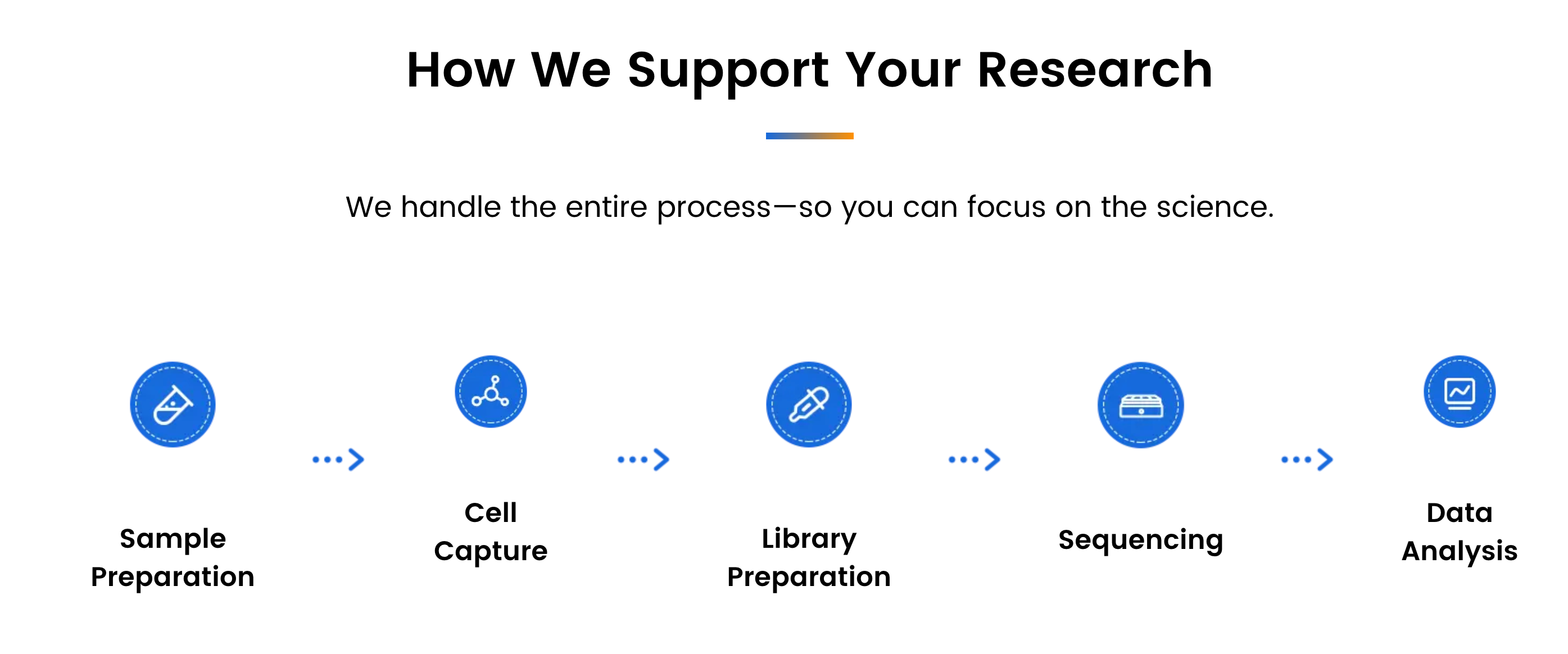
Tell us about your samples and study objectives — we can help evaluate whether a 10x Flex workflow is suitable and suggest a service plan.
Omics Empower is one of the earliest service providers to offer comprehensive single-cell sequencing and Spatial across Asia, Europe, and North America. Equipped with 10x Genomics and Mobidrop platforms, we deliver end-to-end solutions for fresh, frozen, and FFPE samples.
With over 20 000 samples processed and 500 publications supported, our global teams in Hong Kong, Germany, and the U.S. help researchers unlock transcriptomic insights from fresh, frozen, and FFPE samples.
10x Flex supports fresh, frozen, and FFPE human or mouse samples. Omics Empower provides global 10x Genomics Flex sequencing services with laboratories in Hong Kong, Germany, and the U.S., covering complete workflows from sample QC to sequencing.
Germany: Arnold-Graffi-Haus / D85 Robert-Rössle-Straße 10 13125 Berlin
United States: (CA) 2 Goddard, Irvine, CA 92618
United States: (IL) 8255 Lemont Rd, #1, Darien, IL 60561
Hong Kong: Room 618, Building 6, Hong Kong Science Park, Pak Shek Kok, Hong Kong
Germany: Arnold-Graffi-Haus / D85 Robert-Rössle-Straße 10 13125 Berlin
United States: (CA) 2 Goddard, Irvine, CA 92618
United States: (IL) 8255 Lemont Rd, #1, Darien, IL 60561
Hong Kong: Room 618, Building 6, Hong Kong Science Park, Pak Shek Kok, Hong Kong
Germany: Arnold-Graffi-Haus / D85 Robert-Rössle-Straße 10 13125 Berlin
United States: (CA) 2 Goddard, Irvine, CA 92618
United States: (IL) 8255 Lemont Rd, #1, Darien, IL 60561
Hong Kong: Room 618, Building 6, Hong Kong Science Park, Pak Shek Kok, Hong Kong